STOCK MARKET COURSES FOR LONG-TERM INVESTING
There are many methods or systems for investing in the stock market, but if we want to simplify things, we can say that stock market investment is divided into two main groups: technical analysis and fundamental analysis.
What you should know about these two major investment systems is that, while with technical analysis you can make buy or sell decisions by only analyzing the chart of an asset, with fundamental analysis you must invest by analyzing the accounting of listed companies.
Which of these systems is better? Let me tell you right now, neither offers any guarantees. It's up to each investor to choose one or the other (some investors opt to use both).
This article is dedicated to courses for doing fundamental analysis.
What are the best fundamental analysis courses for valuing companies?
Unlike technical analysis, where the strategies applied can be very different from each other, in fundamental analysis there are no secrets.
The truth is that you could learn about fundamental analysis with a couple of good books on the subject: 'The Intelligent Investor', 'The Little Book That Still Beats the Market', or 'The Little Big Book of Value Investing' are excellent books to start with to familiarize yourself with this investment methodology.
The truth is that you don't need a course to invest long-term.
The DCA (Dollar-Cost Averaging) in index funds or ETFs that replicate global indices (such as the S&P 500 or the MSCI World) strategy has proven to be the most effective and efficient for the vast majority of investors who are not professionals in the sector.
Its advantages are unbeatable for ordinary people:
- Simplicity: It does not require advanced technical knowledge.
- Low Cost: ETF fees are minimal.
- Diversification: With a single purchase, you invest in hundreds or thousands of companies.
- Discipline: Automate investing and eliminate the emotional factor of trying to "guess" the best time to buy or sell.
Delving into fundamental analysis, business valuation, or macroeconomics is a fascinating field, but for the purpose of protecting and growing savings, the evidence shows that it is more of an intellectual hobby than a necessity.
Therefore, if you want to learn about company valuation, I assure you these courses won't disappoint, but the truth is, you don't need a course to invest long-term. Using dollar-cost averaging (DCA) and choosing a good ETF is enough.
Discover the ideal broker, course, or funding account for you with the help of AI.
- 📊 Tailored recommendations, based on your profile
- 🧠 Learn about investing and trading for free
- 🔍 Ideal for beginners and growing traders
The best courses to get started in fundamental analysis
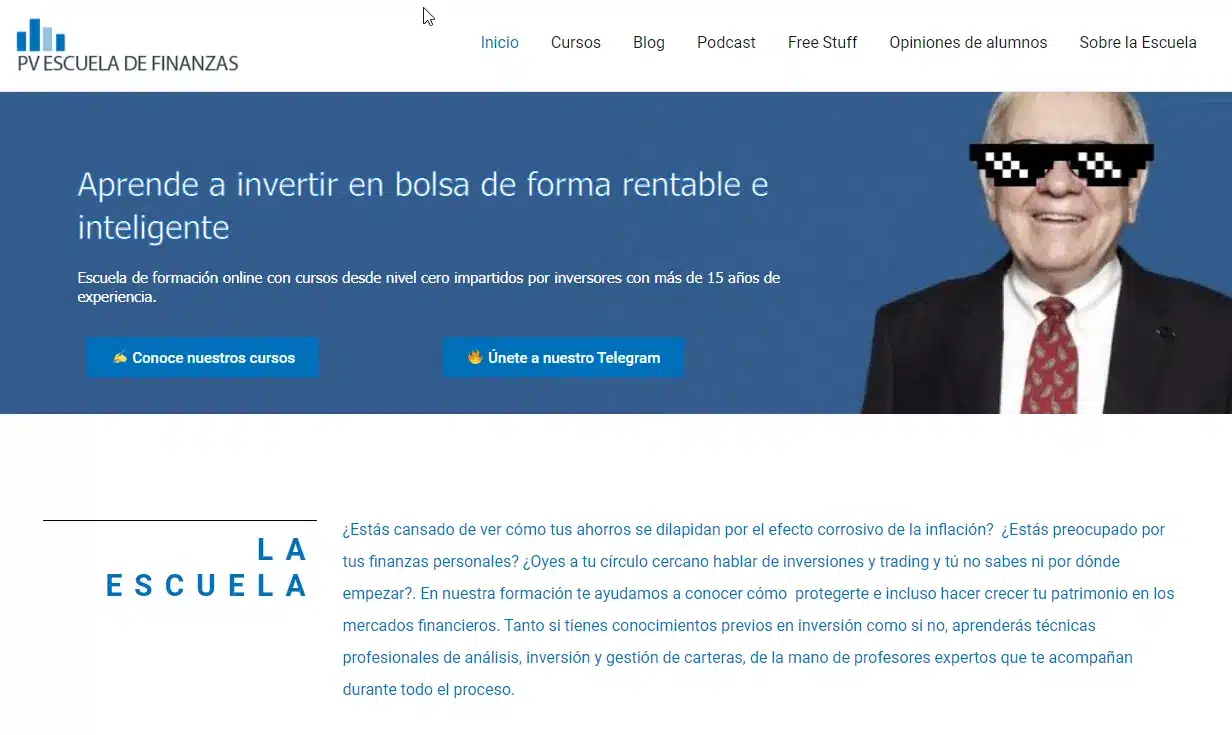
PV School of Finance by Enrique Valdecantos
- Read the review of the course "Expert in Personal Finance and Business Valuation"
- More information: www.precioyvolumen.com
The course offered by Enrique Díaz Valdecantos (@Valdecantos) through his investment and trading called PV Escuela de Finanzas, is now my long-term investment course , and this is basically for two reasons.
The first of these reasons is E. Valdecantos himself . This renowned Spanish trader has managed to carve out a prominent place for himself in the Spanish-speaking investor community over the years.
He is accredited as a European Financial Advisor (EFPA) , teaches at the University of Alicante in the Expert in Stock Markets program , has a Master's degree in "Stock Market Analysis, Financial Investments and Business Valuation" from the University of Seville , and a Specialization in Private Banking and Financial Advice from IEB .
In addition to all this, he has published several books, including the fantastic book called: 'The Wyckoff Method'(one of the first books on the stock market and investment that I have read and definitely one of my favorites).
Every consistent trader's story involves a lot of trial and error.
What will you learn with this Finance Expert training?
Get your questions answered right now via WhatsApp
PV Chat School of FinanceAs I mentioned before, there's no shortage of resources online for learning how to invest in the stock market by analyzing company finances . Even a quick Amazon search will turn up some of the best books on value investing .
However, it can be very difficult to know how to interpret all this information. That's why a good mentor is almost indispensable, and Enrique Díaz Valdecantos excels in this role, both for his knowledge and his pedagogical skills.
With his dynamic and intimate style , E. Valdecantos will bring you closer to the three financial statements of companies: the income statement, the balance sheet, and the free cash flow statement (this is what is analyzed in all business valuation courses, which is why I say that the content is not what differentiates these courses, but the way in which this content is transmitted).
Business accounting is never easy to understand, however in Valdecantos ' classes it seems to adopt a somewhat more friendly format.
Remember that what we aim for when delving into business accounting is to be able to value companies through their debt, revenue, free cash flow, etc.This task is done purely and exclusively with a cold spreadsheet; and keeping students' attention with Excel as the only tool is no easy feat. Valdecantos, however, makes the difficult seem simple.
But be aware, doing things simply doesn't mean doing things in a simplistic way. Valdecantos doesn't skimp on details or effort in any of his classes. The work Valdecantos does as an instructor is enormous.
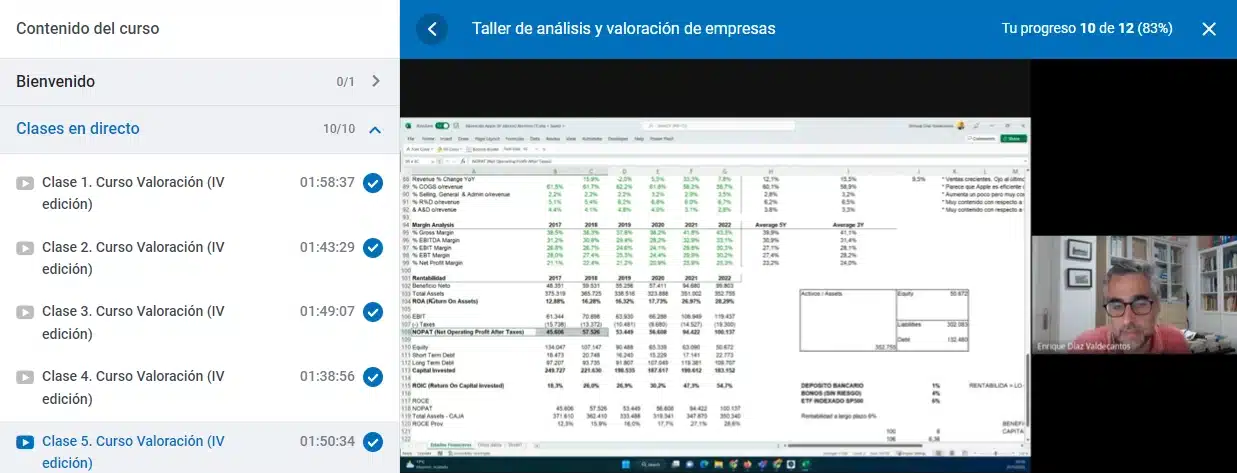
The second reason I chose this stock market course is also related to Valdecantos. Specifically, I'm referring to his background as a trader (keep in mind that trading and investing are different things; I discuss this further at the end of the article).
Unlike other trainers, E. Valdecantos knows as much about fundamental analysis as technical analysis; in fact, he is the author of one of the best books I have read on the Wyckoff (I already told you that, I know).

PV SCHOOL OF FINANCE: BUSINESS VALUATION COURSE OUR CHOICE
A book that complements a very good program about Richard Wyckoff and that is offered through the same Valdecantos stock market academy: PV School of Finance.
You can read my review of this 'Wyckoff Specialization Program' here.
Valdecantos himself tells us that, for him, the best system for investing in the stock market is a combination of technical analysis + fundamental analysis, something with which I totally agree.
The aim of this expert course in finance and portfolio management is that, upon completion, you will be able to analyze and value companies like professional managers do.
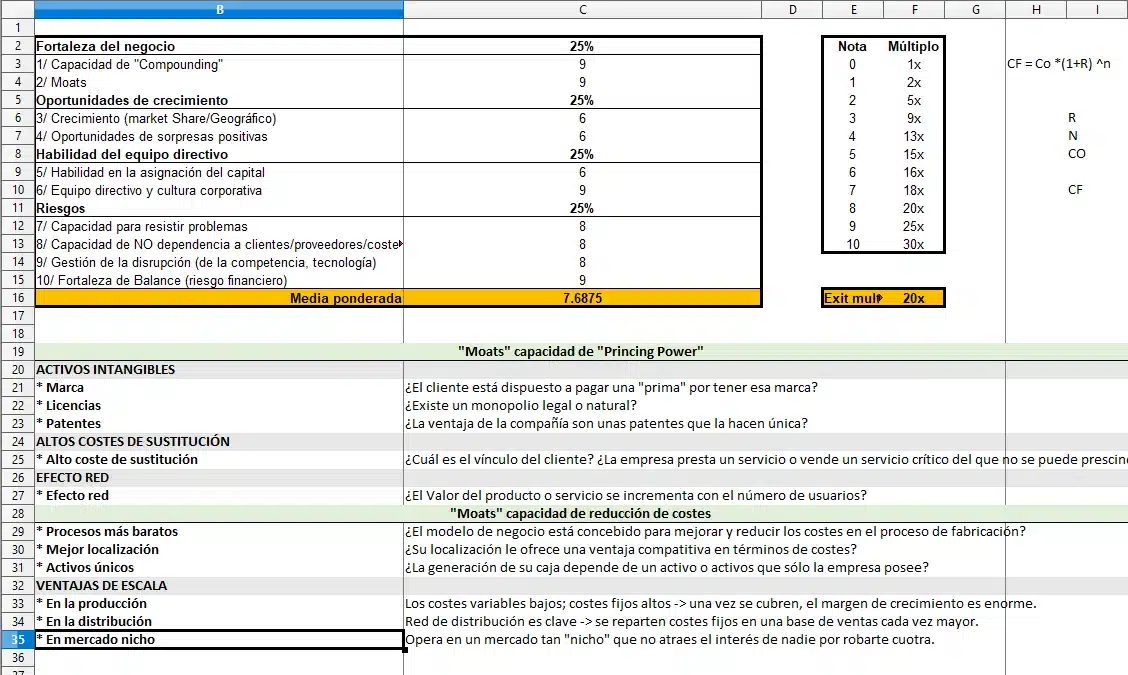
In many ways we can say that this is a very good value investing course , but it goes far beyond value investing, as you will also work on personal finance, portfolio management, business modeling, and even technical analysis via Wyckoff.
The goal is to buy shares of companies trading below their intrinsic value, with the aim of making long-term profits. It's based on the premise that the market sometimes undervalues companies and therefore offers opportunities to acquire shares at a price lower than their true worth.
By the end of the course, you'll be able to identify companies undervalued by the market so you can buy them at a low price. The rest is patience and knowing how to wait, since this investment style is designed to yield long-term returns.
Regarding the course format, you should know that this is an investment course with more than 60 hours of instruction distributed across different sessions or modules.
The great thing about this business valuation course is that it combines pre-recorded video material with live classes. In fact, most students watch the recorded classes and then attend the live sessions.
You should know that once you finish the course, you'll have indefinite access to the campus
to view the content whenever and as often as you like. This isn't something offered in all investment courses; in fact, the vast majority of schools limit access to one year.
The truth is that having lifetime access to the school's materials is something that greatly helps those starting out in stock market investing, because it really takes time to assimilate all the concepts that investing entails.
This course is for you if you are looking to buy stocks in order to build a portfolio that will last you for several years.
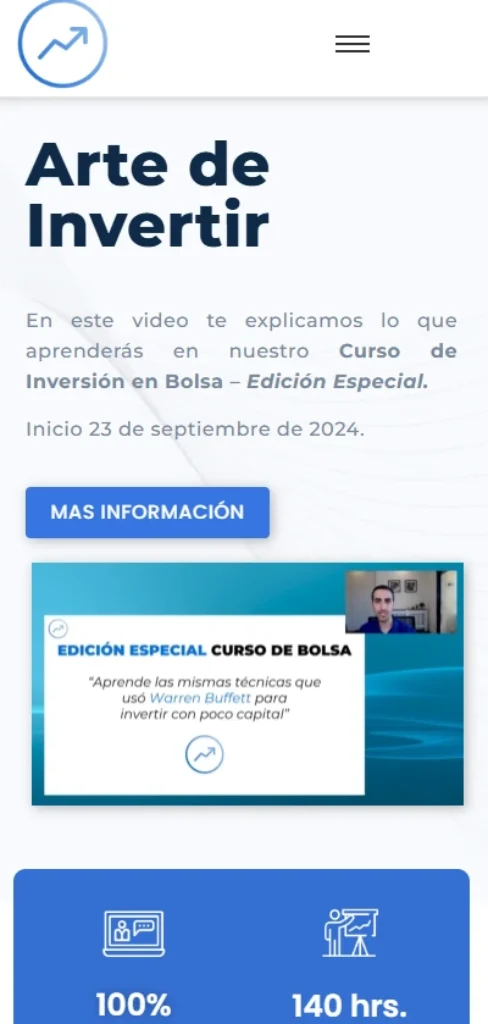
The Art of Investing by Alejandro Estebaranz
More information: www.artedeinvertir.com
Alejandro Estebaranz (@alex_estebaranz) of Arte de Invertir (www.artedeinvertir.com) is a well-known fund manager in Spain (currently at the helm of True Value).
But his popularity shouldn't be attributed to his work as a fund manager, but rather to his YouTube channel called "The Art of Investing." It's one of the most visited channels by those starting out in long-term investing, and I highly recommend it.
As with many other fundamental analysis , the foundations of what is taught here can be found in the investment strategies used by Warren Buffett or Peter Lynch. In other words, this course offers value investing.
The Art of Investing seeks to provide students with all the necessary tools so that they can identify quality companies and invest in them.
The main pillar of the methodology proposed in the course is undoubtedly the analysis of each company's accounting, but you will also learn about portfolio management, investment psychology, risk/return management, etc.
If you're still unsure what fundamental analysis , you'd do well to watch the two introductory videos on stock valuation that Alejandro has on his channel: How to Value Stocks Part I and How to Value Stocks Part II. This will clear up any doubts you may have about this stock market investment system.
Regarding the format of this investment course, it's important to know that Alejandro Estebaranz's course is live and conducted exclusively online. The advantage of the live format is that the content is up-to-date and the company examples used are current. The disadvantage is that the classes can become long and repetitive (even tedious).
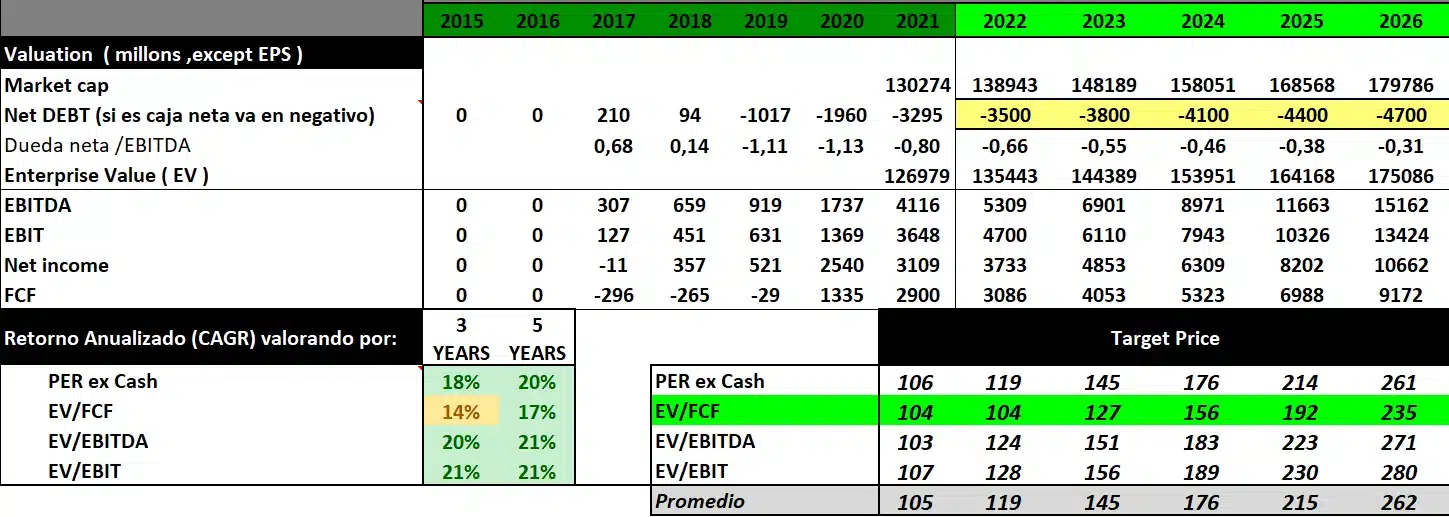
At the end of the course you should be able to value a company using what the school calls: Valuation Tool.
This is simply an Excel template that you will need to fill in with the data of the company being analyzed (PER, EV, FCF, EBIT, etc.) in order to determine whether there is an interesting buying opportunity or not.
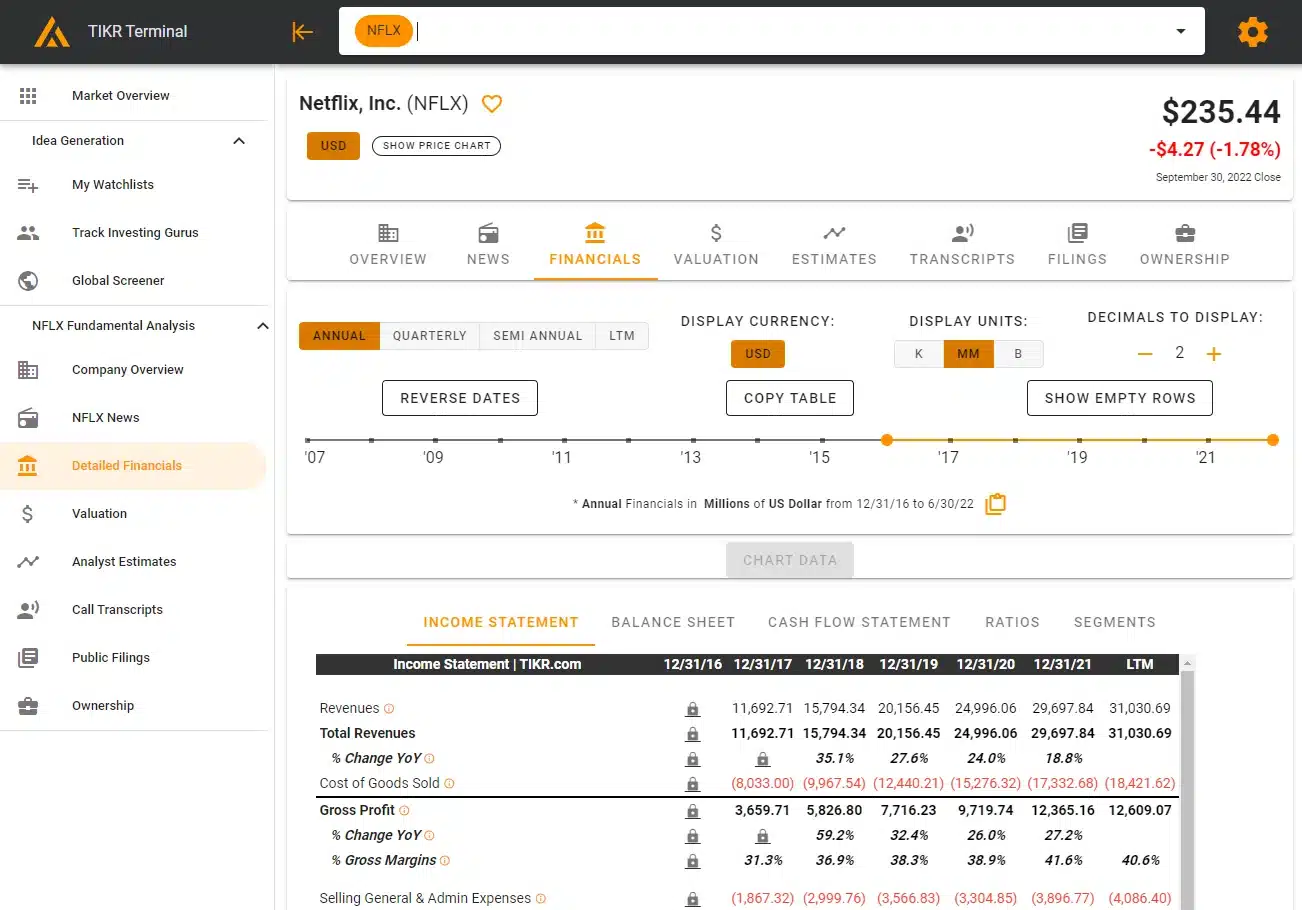
Company data is usually obtained from TIKR Terminal (you need to create an account to access company data) and is usually public; the difficult part is knowing how to interpret it.
It's important to know that this isn't a course for those who enjoy analyzing charts, nor will it be useful if you're looking to invest in the short to medium term. This stock market course is designed for those with significant capital who are thinking long-term (at least 5 to 10 years).
With this type of investment methodology, you're unlikely to buy more than two or three companies per year. This isn't a course that will teach you how to speculate on cryptocurrencies or Forex (What's the best Forex course?), it's a course for investing exclusively in companies you like (and not holding onto them for a long time).
INVEST FROM ZERO

- Read the review of Investing From Scratch
- More information: www.invertirdesdecero.com
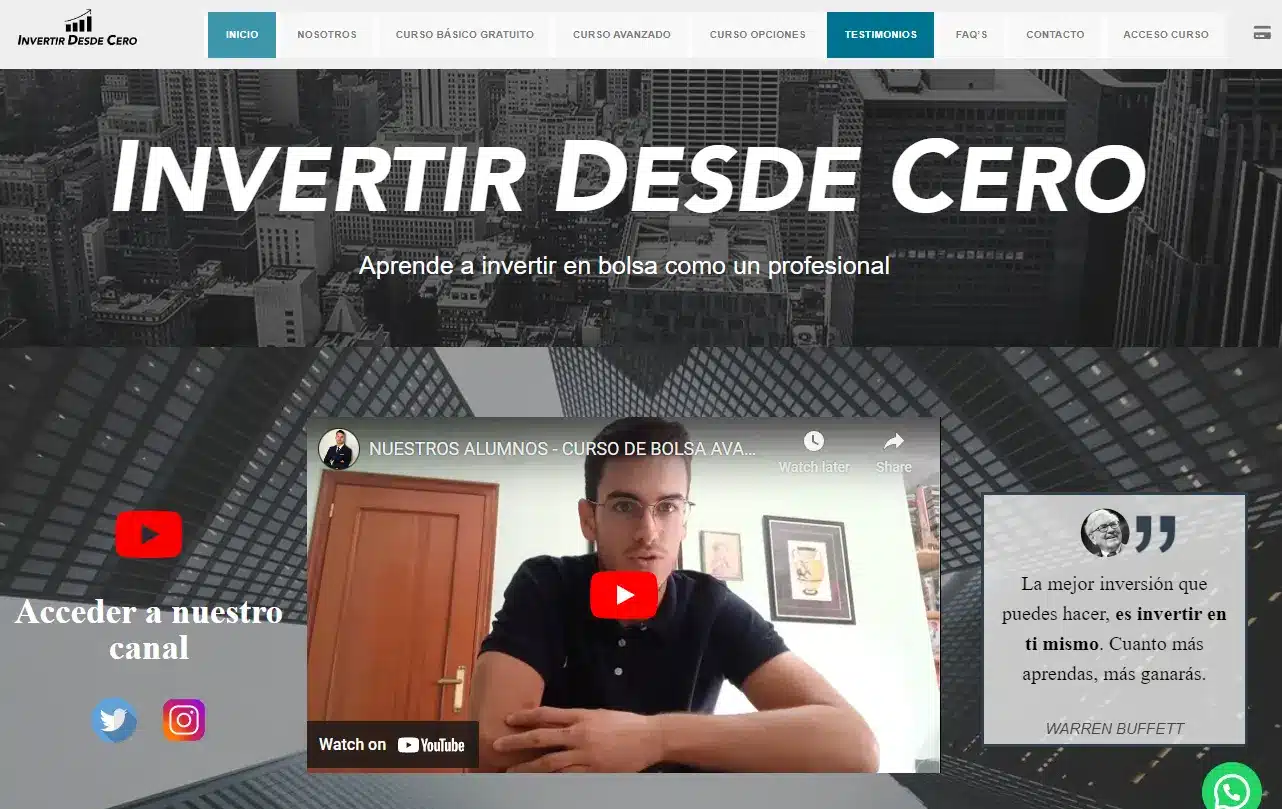
Investing From Scratch (www.invertirdesdecero.com) is another stock market course focused on valuing companies through value investing. It offers everything you need to analyze a company's fundamentals. You'll delve into the analysis of free cash flow, corporate debt, EPS (earnings per share), and more.
Fernando Sánchez (@InvertirDesde0), the person in charge of this course, has a vast experience in fund management (remember that Fernando was a collaborator of Alejandro Estebaranz at True Value), which is why the course is full of personal anecdotes, and advice that can only be acquired with experience.
The foundations of this course are the modules of: 'Accounting', 'Stock Valuation', and 'Guide to Analyzing and Valuing a Company From Scratch' (it is a course very similar to the Art of Investing course).
After completing these modules, you will be able to access a 'Valuation Template' (basically an Excel spreadsheet) which is what you will actually use to assess whether a company is undervalued and you should invest in it, or on the contrary, whether the market is paying above its value.
The classes in this course are also live (with the pros and cons that this entails), of course you can always watch the recorded classes the next day if you were unable to join them when they were taught.
One thing I really dislike about this value investing course is that access is limited to one year. While a year might seem like a long time, it's not really when you're not dedicating yourself exclusively to the course.
Many of the concepts are complex, and analyzing a company isn't as simple as it seems. Being able to rewatch certain videos or review the course material is essential for me; apparently, the school doesn't share my opinion, and after a year you're out (unless you pay extra).
Despite these details, I must say that Investing From Scratch is a very good course in fundamental analysis.
Familiarizing yourself with Fernando's work through the Investing From Scratch YouTube channel may be the best way to find out if this is the course you need.
What does fundamental analysis study?
As I've already mentioned, fundamental analysis studies companies' accounting. In other words, what you're interested in analyzing when doing fundamental analysis are the three financial statements of companies, and these are:
- The Income Statement.
- The Balance Sheet.
- The Cash Flow Statement.
Apple, example of an Income Statement:
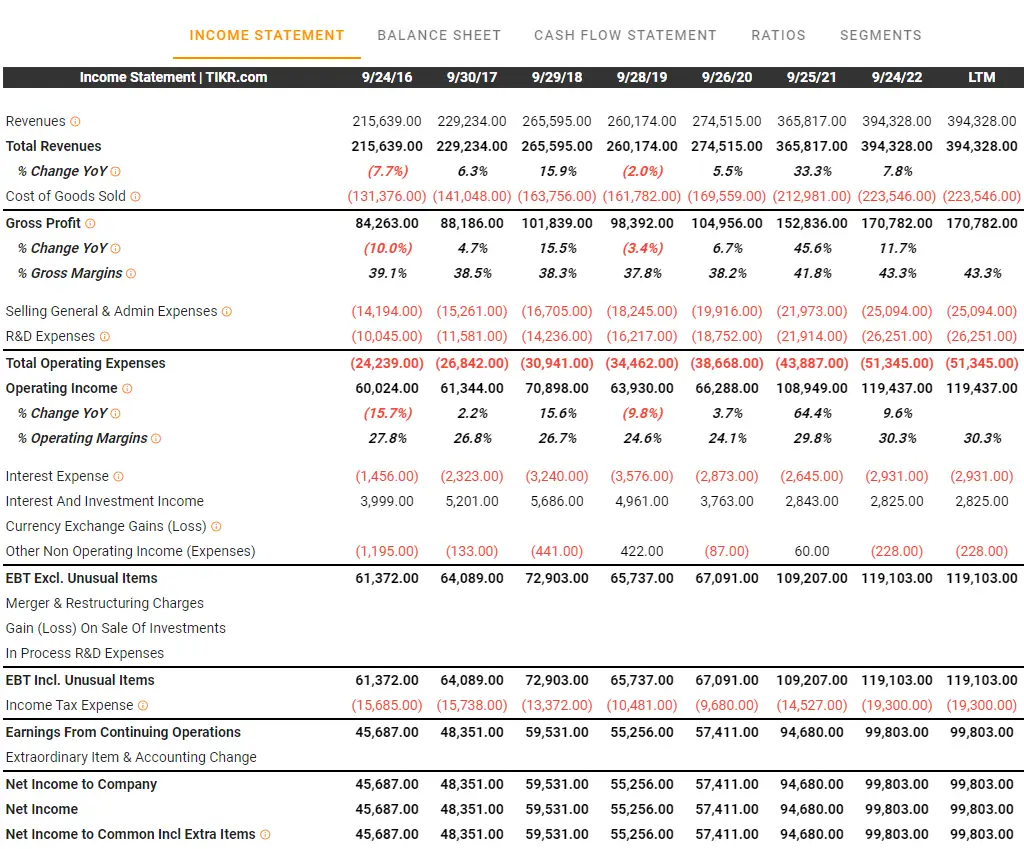
But it's not all about company accounting, because when doing fundamental analysis you should also look at possible future expansion plans, the sector to which the company belongs, or the economic environment of the country or countries in which it operates.
The truth is that those who do fundamental analysis are not looking to speculate on stock prices; on the contrary, those who practice this type of stock market trading seek a very long-term relationship with the company in which they invest.
When you do fundamental analysis, you want to know everything about the company you're investing in.
You want to know their numbers, but also the management team, the CEO, and if possible, the wife's/husband's family, the mother-in-law, and even the dog.
You want to fall in love with every detail of the company, and you won't care if the stock price falls in the coming years; your time frame will be, at best, forever.
Not all investors are the same
Value investing is usually the preferred system for long-term investors who do fundamental analysis.
Does this mean that this type of investment is better than technical analysis? Absolutely not. There are never any guarantees. Nokia, Terra, Popular, Bankia , and a very long list of failed "holds" confirm this.
The truth is that some investors will adapt very well to this type of stock market operation, while others will suffer from it from the very beginning.
Fundamental analysis , in all its forms, is characterized by a long-term perspective and a strong emphasis on patience (a lot of patience). Essentially, this type of stock market strategy proposes: buy and do nothing for a long time.
Having significant capital to operate with is also recommended, as you will get little benefit from this type of investment with modest capital.
Clearly, fundamental analysis isn't for every type of investor. Only you can know if this type of investment suits your personality and lifestyle (but this is true for any investment or trading style).
alternatives to fundamental analysis for medium- to long-term investing, almost all of them linked to technical analysis.
I prefer swing trading (What are the best courses for swing trading?), however, when buying stocks I don't neglect the fundamentals.
Even with a timeframe of a few weeks or months, I prefer to buy companies where investor sentiment is favorable (I rely heavily on Danelfin when choosing which companies to buy).
Other long-term investment options include robo-advisors and ETFs . These last two options don't require a stock market course , but it's always best to have some prior training before investing. Never trust the latest self-proclaimed guru or those who claim to know about investing on social media.
Frequently Asked Questions about Fundamental Analysis
What is the difference between technical analysis and fundamental analysis?
How is fundamental analysis performed?
Which is better, technical or fundamental analysis?
If you're looking to trade in the short to medium term, you can check out the ranking of day trading courses or the ranking of the best stock market courses for swing trading.

My name is Norberto. I've been investing and trading for over a decade. I'm also the author of the Topstep Experience trading course. If you want to learn how to invest and have any questions, feel free to contact me.
You might also be interested in
HOW TO START INVESTING IN THE STOCK MARKET?

WHAT IS THE STOCK EXCHANGE (AND HOW DOES IT WORK)
Discover how to start investing in the stock market with this guide…

WHERE TO STUDY TO INVEST IN THE STOCK MARKET?

THE BEST STOCK MARKET COURSES FOR INVESTING IN STOCKS