THE BEST STOCK MARKET COURSES FOR INVESTING IN STOCKS
How do you buy stocks? This is probably the most common question among those starting out in the stock market. The truth is, buying stocks is relatively simple.
The difficult part is knowing which stocks to buy, but for that we can use two systems: look at the finances of the companies (fundamental analysis), or look at the chart with the price of the stocks (technical analysis).
In this short ranking, I'll tell you about the best stock market courses for buying shares. The first course will cover investing through fundamental analysis, while the others delve deeper into the various strategies offered by technical analysis.
What are the best stock market courses for investing in stocks?
Below you'll find what are very likely the 4 best stock market courses for investing in shares. Each of these courses is undoubtedly the best in its field. However, you should remember that every trader is unique.
This means that the best stock market course for you will always be the one that best suits your needs as an investor (How to choose a stock market course?).
Depending on your personality and lifestyle, you can choose to trade stocks by day trading, swing trading, or long-term investing.
You might even prefer to do it with fundamentals by betting on value investing (What are the best value investing courses?).
The truth is, there's no single trading course that works for every trader. Therefore, when choosing a stock market course, first consider what kind of investor you want to become, how much capital you're willing to invest, your risk tolerance, your availability and trading schedule, and so on.
All these questions are valid and you should consider them before choosing your stock market course.
I can share my experience with different stock market coursesand try to help you choose one. But the final decision must be yours.
The best stock market courses for investing in stocks:
ORDER BOOK TRADING by Ferran Font
- Read Ferran Font's Review
- More information: www.orderbooktrading.com
The secrets of a world trading champion
Ferran Font is one of my favorite traders and his stock market course called 'Order Book Trading' (www.orderbooktrading.com) is one of the ones I most often recommend.
And while it is true that this is not an exclusive stock trading course (with Ferran you can trade Forex, Futures, ETFs, Cryptocurrencies, Options, and of course also Stocks), the truth is that much of what you can learn in this trading course applies to stock trading.
Ferran Font on WhatsAppThis is another course that focuses on technical analysis and swing trading. However, you should know that Ferran Font's approach isn't limited to a single trading system or timeframe.
Ferran knows that not all traders are the same, and that is why he offers you a 'tasting menu' where you will find strategies for swing trading, but also for intraday or long-term.
These strategies can be derived from Price Action, Order Flow, Volume/Market Profile, or market structure. I don't think I'm exaggerating when I say that this stock market course is one of the most flexible on the market.
The best thing about the course is that Ferran holds nothing back, making years of experience in the markets available to you (you can tell he's a trader who trades daily, I'm clarifying this because not all trainers actually trade).
What to include in your trading plan will then depend on your personality and lifestyle .

FERRAN FONT: ORDER BOOK TRADING OUR CHOSEN ONE
If you want to familiarize yourself with this great trader's approach, I suggest you sign up for one of the free MasterClasses that Ferran usually offers.
Opinions about Ferran Font's course
I highly recommend this course; ORGANIZED, COMPLETE AND VERY WELL STRUCTURED.
Anyone who, like me, is looking for a professional change in trading and demands preparation, experience, seriousness, and availability must take Ferran's PROFESSIONAL COURSE.
You have theory, interpretation of the behavior of variables in the graphs, practice with the demos, but above all Ferran's step-by-step guide which is very valuable.
In my opinion, Ferran's course is key to entering and understanding the chaotic world of trading. You'll have all the tools and continuous guidance you need to succeed. The only thing that depends on each individual is the time and dedication they invest, because everything else will be available.
Tammy Daniela FK*
* You can find more opinions about Ferran Font in the comments section of the course review.
Ferran Font's YouTube channel is another great place to learn about the work of this world trading champion.
STOCKS TRADING CLUB by Edu Trades


- Read the Stocks Trading Club
- More information: www.stockstradingclub.com
Day trading with small caps with a professional trader
Edu Trades, the creator of this course, offers a unique opportunity to learn how to trade small-cap stocks. This isn't a course for investing in stocks, but rather for speculating on price volatility.
In other words, what Edu is not a traditional investment course, but pure and simple day trading, bordering on scalping.
Small-cap companies are small to medium-sized businesses with low market capitalization. That is, stocks with a market capitalization between $250 million and $2 billion (this can vary slightly). This low capitalization makes these companies highly volatile, which can lead to significant profits for those who know how to capitalize on these movements (and Edu knows exactly how to do that).
Edu talks about a very peculiar and specific pattern in small caps, a kind of pump and dump that has allowed him to turn USD 2000 into more than a million dollars (here you can see his track record).
The course is offered on a subscription basis and is divided into 10 modules including 'Technical Analysis of Small Caps', 'Fundamental Analysis Applied to Small Caps', and 'Strategies in Small Caps'. In addition, there is an extra module of tutorials and another for Q&A (questions and answers).
The best part is that the monthly subscription is very affordable (less than $100 USD per month). It also includes access to a Discord server where Edu and his students share their trades, ask questions, and provide analysis.
Attention: If you stop paying for your subscription, you will lose access to the course and the Discord server.
Without a doubt, one of the best courses I've ever taken, but it's not for everyone. Before taking the course, you must be very clear that what you're looking for is day trading small-cap stocks, and be willing to commit to what's taught here, as it's a trading course that requires commitment and effort.
It's also important to clarify that what you learn in this course won't help you trade Forex, cryptocurrencies, or funded accounts. It's only applicable to trading small-cap stocks; the strategies can't be applied to other markets.
I encourage you to read my full review to find out if this course is exactly what you were looking for.

STOCKS TRADING CLUB RECOMMENDED
Uxío Fraga's Professional School for Traders
Swing trading with a market veteran
Uxío Fraga is a well-known figure among much of the trading community in Spain. Therefore, it's no surprise that his stock market course (www.novatostradingclub.com) is included in this ranking of stock market courses.
Unlike other stock market training that prioritize intraday trading, Professional School of Traders focuses on swing trading (What is the best course for swing trading?). It's important to clarify, however, that what you learn in this course isn't limited to stocks; you can also apply it to cryptocurrencies or ETFs.
Uxío Fraga presents a simple investment system based on the structural analysis of support and resistance levels, where trade management and risk are key to success. Here you'll find everything you need to speculate on stocks: entry and exit techniques, Weinstein's phases, types of trades, risk control, position sizing, and more.
The best part of the course, however, is the personalized support offered by the school. Typically, in addition to the theoretical modules, you'll have between 15 and 20 one-on-one sessions with the academy's traders. Without a doubt, this is its strongest point. The school has done an excellent job selecting its team, and the experience is truly enjoyable.
If you're interested in Uxío's work, I recommend checking out the school's blog. You'll find many high-quality articles there. Another option is the Novatos Trading Club YouTube channel.
And if you need more information, you can always arrange an interview with the school.

PROFESSIONAL TRADERS SCHOOL: NOVICE TRADING CLUB RECOMMENDED
THE WYCKOFF METHOD by Enrique Valdecantos


- Read the review of 'The Wyckoff Method'
- More information: www.precioyvolumen.com
The ABCs of trading
Although this isn't strictly a stock trading (you won't learn how to select stocks here, though they do teach you how to use a stock screener to find them), I believe E. Valdecantos deserves its place on this list. I'm referring to his stock market course: 'The Wyckoff Method'.
Wyckoff is one of the few systems that allows you to put what the market is doing or saying into context. With Wyckoff, you can read the market's meta-language, which every trader must know how to interpret when investing in the stock market. The key, as always, lies in the price and its relationship to the trading volume.
Valdecantos has done a great job shaping this stock market course, combining elements of technical analysis with Richard Wyckoff 's approach .
The truth is that Wyckoff remains one of the best ways to interpret the intentionality of the institutional game through the different phases of accumulation/distribution and of supply and demand.

PV SCHOOL OF FINANCE: THE WYCKOFF METHOD COURSE RECOMMENDED
It's worth noting that the Wyckoff methodology can be adapted to almost any asset or timeframe. However, I believe it's with stocks, particularly those with a medium- to long-term investment horizon, where it's most effective.
With a real-time trading room, various complementary workshops, the possibility of sharing ideas with other traders, etc., this stock market course is one of the best options you will find on the market today.
How much money is needed to invest in the stock market?
"Investing in the stock market" is a very general term, as the assets in which we can invest are numerous and very different. Among the best-known assets are Forex, Futures, Options, and of course, Stocks. But there are others, such as ETFs and CFDs.
Depending on your investor profile and the asset you wish to trade, you will need more or less money.
The answer to this question is also linked to your goals as an investor. Investing in the stock market through swing trading to supplement your monthly income is not the same as choosing the stock market to protect your money from inflation.
The truth is, you don't need a lot of money to invest in the stock market. Keep in mind, however, that the returns you can expect are usually related to the amount of investment you're willing to make.
If you invest $1,000 in a spot stock trade, you can expect to earn $100, $500, or even more with a bit of luck (but be aware that you can also lose these amounts if your risk management isn't good). What's not realistic is expecting to earn $100,000 by investing $100.
I know what you're thinking. You have a friend who bought $10 worth of cryptocurrency and now you see him driving a brand new car. Yes, anything is possible. But it's not the norm. Stocks typically move 1%, 2%, maybe 4% in a single day.
Sometimes we get lucky and find a company that yields a 30% or even 50% return in a very short time. But that's not the norm.
Investing with little money is possible
As an example of what I'm saying, I've included a screenshot below showing my trading performance over the last 12 months (+31%). Keep in mind that I'm a very easygoing trader.


So, if you plan to invest in stocks in the medium to long term, it makes sense to aim for consistent and moderate returns. Based on these returns, you can get an idea of what you'll need to trade stocks, buying and selling shares according to your budget and interests.
But as I said before, stocks are just one of the assets you can choose from. Investing in Forex, Futures, or stock CFDsis a different story.
The time frame you choose for your investments also has a significant impact. For day trading (here's a ranking of the best stock market courses for day trading), you'll likely need less capital than for long-term.
Eventually, you'll need to find your own trading style. Based on all these variables, you'll be able to determine the amount of money you'll need to trade on the stock market.
What do I need to know to invest in stocks?
You clearly need to get trained to invest in stocks. There are basically two ways to do this, and you've probably already heard of them:
- Fundamental Analysis
- Technical Analysis
With fundamental analysis, you'll delve into the inner workings of companies. You'll examine their debt, EBITDA, cash flow, EPS, and more. Many investors choose this type of stock market investment (particularly those who invest long-term using value investing).
Another option is to do it via technical analysis (all the courses mentioned in the ranking I shared above are technical analysis courses). This is a way of trading on the stock market that doesn't require analyzing company finances, but rather analyzing price charts.
Which investment or trading system is best?
There is a great deal of debate regarding which of these systems is better. Usually, in the rankings of the world's best traders/investors, those who use technical analysis and those who use fundamental analysis are evenly distributed.
My personal preference when it comes to stocks is to combine a bit of both worlds.
The only unviable option when investing in stocks is not to educate yourself beforehand. If your intention is to invest in the stock market without taking an investment course, the best thing you can do is invest in a Robo Advisor (or an ETF).
What type of investor are you?
Answering this question is perhaps the most important and difficult task we will have to solve on our path to becoming investors (or traders, if you prefer).
I've discussed this topic in several of my articles about different stock market courses, and the conclusion is always the same: every trader is unique. That's why you won't find an investment system that suits everyone. Some traders prefer day trading, others medium- to long-term trading, some trade forex, while others trade stocks. The combination of options is enormous—one for every trader.
Finding your style is what will ultimately make you a successful trader. It doesn't matter if you're day trading or swing trading; with stocks or futures. What matters is that you find an investment style that suits your personality, lifestyle, capital, and risk tolerance.
The best scalping course in the world is useless if you don't have the time to spend two or three hours a day staring at the charts. It's even less effective if your personality isn't suited to the demands of scalping (this trading style is particularly intense and not for everyone). Similarly, an excellent long-term investment system with 2% returns is useless if your capital is only $1,000. Are you interested in making $20 in five years? I doubt it. Clearly, this system would only work for someone with a lot of money.
Is this bag for me?
Another difficult question to answer. With so many investment systems and assets available, it's very difficult to answer this question without having experienced several of these systems beforehand.
And obviously, I can't answer this question for you. But what I can tell you is that even if the stock market isn't for you, you should think about investing your money so that your savings don't lose value due to inflation. Keeping money under the mattress isn't a wise option for anyone who wants to protect their savings. Neither is the bank (I'm sure you already know that).
The chart below shows what you could have earned by investing just one dollar in the S&P 500 in 1927. Adjusting for inflation, that dollar would have yielded $608.45 (60,844.74%). On the other hand, if you had kept that dollar under your mattress, its purchasing power today would be only $0.07 due to inflation.
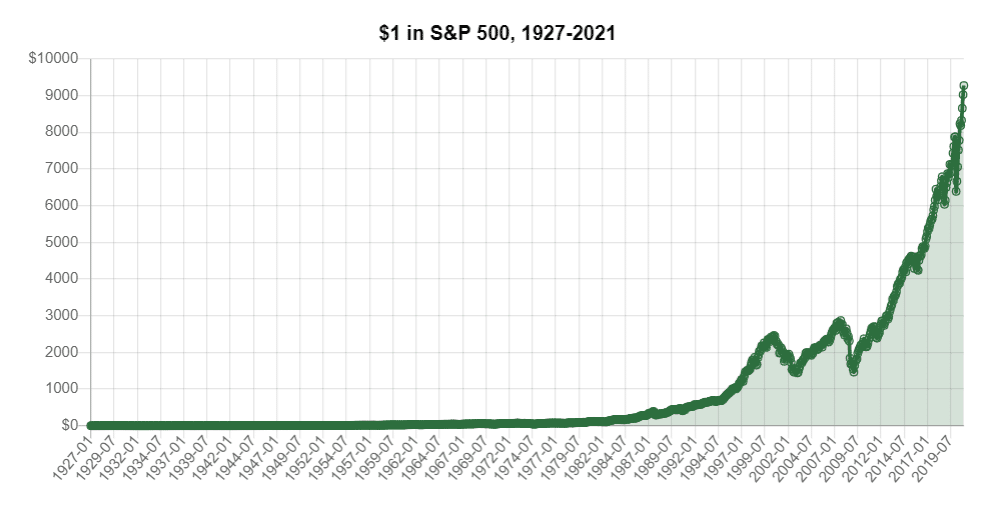
It's clear that equities (investing in stocks) are the way to go. As I mentioned before, a robo-advisor is a good option for those who don't want to learn about investing and want to actively manage their savings (there are other options as well).
Perhaps it would be better to ask: What type of investment is this for me?
My recommendation will always be that you try to educate yourself on financial matters, at least minimally.
Even if you don't actively invest, you shouldn't leave your savings to chance. There's excellent literature you can consult, and clearly some very good stock market courses (as well as some very bad ones, which is why I'm making this ranking).

My name is Norberto. I've been investing and trading for over a decade. I'm also the author of the Topstep Experience trading course. If you want to learn how to invest and have any questions, feel free to contact me.
TRADING AND STOCK MARKET INVESTMENT COURSES: Day Trading vs. Short-Medium Term
How to Start Investing in the Stock Market?

THE BEST COURSES FOR INVESTING IN THE STOCK MARKET BY SWING TRADING
The best courses for investing through swing trading