If you use TikTok, YouTube Shorts, or Instagram Reels, you've seen it before. Someone opens their phone, shows you an app with a clean interface, throws out a couple of numbers, and finishes with the classic: "I have my money here, it gives me X, and I can withdraw it whenever I want.".
And yes, they often talk about Trade Republic (yes, they are very, very annoying).
I'm not going to tell you that Trade Republic is "bad." It's not about that. It's about something else, something more uncomfortable. It's about what YouTubers leave out. About what they can't tell you when the content depends on an affiliate link.
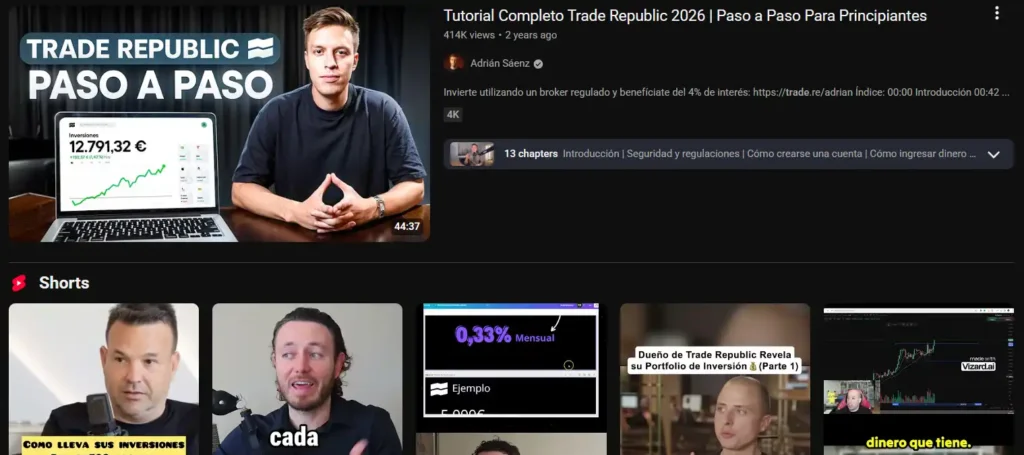
Adrián Saenz acting as spokesperson for Trade Republic… season 3 episode 34
So let's do what almost no one does. Provide context. Include the fine print. Present real-life scenarios, from an ordinary person who works, saves, invests a little, and doesn't want any surprises.
And since we're talking about context, I'll start by telling you what the OCU is: The OCU (Organization of Consumers and Users) is the largest consumer organization in Spain. It's where consumers complain when things don't work as they should.

Trade Republic with a 'VERY BAD' rating on the OCU website
Basically, the OCU is where people go to complain about Trade Republic (and therefore where you can read things that are not usually said on YouTube).
You can see all the complaints that Trade Republic has accumulated with the OCU here

Millions trust it? Really? It must be the YouTubers who get paid on commission… because everyone else at the OCU complains
Trade Republic and the opinions in the OCU
This article largely summarizes what people say when filing a complaint with the OCU (Spanish Consumer Organization). Keep in mind that a complaint to the OCU is not like ranting on a forum, so… be careful with Trade Republic.
First: what is Trade Republic and why is it everywhere
Trade Republic is a broker and investment platform based in Germany. It has become popular in Spain for four very specific reasons:
- The app is simple (compared to traditional banks).
- Very low commissions (and sometimes zero on certain products).
- The interest-bearing account (depending on the time and conditions offered).
- The number of clownish influencers who claim to use the app.
The first three are gold for an influencer. They're easy to explain. Easy to record. Easy to turn into a promise.
But here's the first reality.
An app is not a financial plan. An app is a tool. And a tool, if you use it without understanding it, won't protect you from anything.
"It gives you interest on idle money" (the savings account), yes. But it's not magic
What is usually sold is: “Put your money here and they pay you X%”.
What is almost never explained well is:
- That percentage can change. It's not a fixed-rate mortgage. It depends on interest rates, internal conditions, promotions, and limits.
- There may be limits: up to a certain amount, for a certain time, or under certain rules that change.
- Earning interest on cash is not the same as investing. Many people get confused and think they are "already investing" when in reality they are only receiving interest on their balance.
And this is important because psychologically it relaxes you. It makes you feel like you're already doing "the right thing." And that's where self-deception begins. Because you can be earning an acceptable interest rate and still be mismanaging your money if:
- You don't have a real emergency fund,
- You're paying off expensive debts,
- Or you're taking a risk without knowing it (we'll see that now).
The words that don't appear in reels: custody, omnibus accounts, and where is your money?
This is where short content falls short. Because explaining it well takes time.
When you use a broker, something like this usually happens:
- Your money is deposited into accounts at partner banks,
- Your securities are registered under a custody system,
- and you are the financial beneficiary.
Many brokers use omnibus accounts, which basically means that the securities are registered "in the name of the intermediary" and then internally allocated to each client.
Is it illegal? No. Is it weird? No. Is it automatically bad? No, it isn't.
But it's something you should know, because in case of operational problems, claims, discrepancies, or bankruptcy, the experience may be different than if everything were in traditional nominative accounts.
And here's what any responsible influencer should say:
- Find out about the custody system and protection scheme applicable in your country and in the intermediary's country.
- Understand what's covered and what isn't. Because many people think "everything is guaranteed," and it's not. It doesn't work that way.
I'm not saying it's dangerous. I'm saying it's not a cologne ad. There's a structure behind it.
You can see my ranking of the best stockbrokers here
“It’s regulated in Germany, so it’s safe” is a lazy phrase
Having a broker regulated helps. A lot. But regulation doesn't mean "nothing ever happens." It means there are rules, oversight, requirements, and processes.
Even so, things happen:
- execution errors,
- app outages during times of volatility,
- delays in transfers,
- incidents with dividends,
- confusions with withholdings,
- Unfriendly tax documentation.
And here's the point: the friction arises when you actually start using it. Not when you open an account and deposit 50 euros to try it out.
Influencers usually get stuck in the onboarding phase. Registration, verification, first deposit, purchase of a popular stock. The end.
Real life is longer.
Taxation in Spain. This is where the romance breaks down
Okay. This topic is a magnet for problems, so I'm going to be clear without getting into unnecessary technicalities.
If you invest from Spain, what matters is:
- how do you declare profits and losses?,
- how do you declare dividends,
- what withholdings apply,
- What information does the broker give you and in what format?
- and if you need to submit additional forms depending on your case.
Spanish banks usually integrate some of this more "automatically" (with their fees, of course). With a foreign broker or one with a more European structure, you'll often have to:
- download reports,
- review data,
- balance operations,
- understand withholding taxes,
- and keep track of purchase and sale prices if you do a lot of transactions.
Can it be done? Yes. Is it impossible? No. Are they going to tell you in a 45-second video? No way.
And here's what they don't tell you: if you trade a lot for fun, you're buying yourself tax work. And sometimes, mistakes.
It's not just about "easy investing." It's about "investing and then declaring your taxes properly.".

Adrián Saenz's behavior with Trade Republic is pornographic. You can't be such a bootlicker
The mental trap of “automatic DCA” and investment plans
Trade Republic (and other similar apps) heavily promote recurring plans. The narrative is appealing: automate, forget, let time do its work.
I'm quite in favor of automation, but with one condition: that you know what you're buying and why.
What isn't talked about as much:
- You can end up buying ETFs or stocks without understanding their composition.
- You can double your exposure without realizing it (for example, a global ETF and then several large tech stocks, and in the end you're over-loaded on the same thing).
- You may pay spreads or implicit costs at unfavorable times, depending on how orders are executed and in which markets.
And the most dangerous thing isn't losing money for a month. The most dangerous thing is building a portfolio out of inertia, because "the app made it easy for me.".
Easy is not always the same as right.
Zero commissions and the topic no one wants to touch: how the broker makes money
Nothing is free. If you don't pay a visible commission, the broker earns money in other ways. This could be through:
- spreads,
- Payments per order flow (according to structure and jurisdiction),
- third-party commissions,
- exchange rates,
- securities lending,
- or premium services.
I'm not accusing Trade Republic of anything shady. I'm stating the obvious: a company has to make money.
And you, as a user, should know where that money comes from. Because it affects:
- the price at which you buy and sell,
- the quality of execution,
- the intermediary's incentive,
- and the type of products that push you.
Influencers often say "low commissions" and that's it. But the adult question is: low commissions, okay. But what's the actual total cost per transaction?
“Buy fractional shares” sounds great, but understand what it means
Being able to buy fractional shares is useful. It allows you to invest small amounts, diversify, and avoid waiting months to buy an expensive stock.
But it also has its own particularities:
- Sometimes you don't have the same rights as with full shares (it depends on the structure),
- There may be limitations when transferring positions to another broker
- Liquidity and execution can depend on how the broker groups orders.
Again. It's not "bad". It's just not magic.
And for someone who wants to invest long-term without complications, it can be perfectly valid. But it's important to know what you're getting into.
User experience is part of the problem, yes, part of the problem
This is strange to say, but it's true.
A pretty app, with smooth graphics, notifications, and mental confetti every time you buy, can push you to trade more.
And operating more, for most, means:
- make more emotional decisions,
- to buy expensive because of FOMO,
- selling cheap out of fear,
- chasing “what’s going up today”.
Traditional banks put obstacles in your way. They bored you. They made you navigate ugly screens. That was bad for the experience, yes. But it also held you back.
In Trade Republic, everything is fast. Very fast. And that's a double-edged sword.
Long-term investing is usually more like watching paint grow than playing a video game.
Customer service and incident resolution: until you need it
Another thing that almost nobody talks about because it doesn't get views: what happens when something goes wrong.
I'm not referring to "the stock price went down." I'm referring to:
- a transfer that doesn't arrive when it should,
- a poorly paid dividend,
- a change of personal data,
- a withholding that doesn't add up,
- a duplicate operation,
- or simply a specific tax question.
On digital platforms, support can be good, slow, or frustrating. It depends. And it also depends on the workload, the country, the time of day, and your specific situation.
The influencer doesn't talk about this because they usually haven't experienced it. Or they have, but it's not worth their while to talk about it.
But you should consider this: what level of support do I need?
If you're going to put in 200 euros to start, fine. If you're going to put in your savings of several years, you might want to ask more questions.
“I have all my money there” – be careful with that kind of phrase
When someone on social media tells you "I have everything here," it sounds like social proof. Like security. Like if they do it, you should too.
But:
- You don't know their true net worth,
- You don't know if that money is a small part,
- You don't know if he has other assets abroad,
- You don't know their risk tolerance,
- You don't know if he has debts,
- And you also don't know if he's being paid to say it.
Simple, almost childish, but useful rule: don't copy portfolios, copy processes.
If someone inspires you, great. But you need your own system. And a system usually includes diversification by entity, not just by asset.
Interest rate and market risk. “High interest rates” don't last forever
There was a time when having a "high" earning cash seemed normal. Then it wasn't. Then it was again.
If you build your financial life around "this app gives me X%", you are assuming that X% will continue, or that there will be equally easy alternatives.
And it doesn't always happen.
When pay goes down, many people will do two things:
- or will he stay anyway because he's already used to it,
- or it will move to riskier products in order to maintain performance.
And that's where bad decisions come in, because jumping from "earnings-for-money" to "tech stocks" isn't a natural step. It's a leap.
ETFs. Yes, they're a good tool. No, they're not automatically safe
Influencers often say, "Buy a global ETF and you're all set.".
I also believe that a diversified global ETF can be a decent foundation. But there are nuances:
- A global equity ETF can fall sharply in a crisis.
- You might need the money just as it falls.
- Diversification reduces specific risk, but does not eliminate market risk.
- People confuse “diversified” with “risk-free”.
And then the typical thing happens. First serious scare, a 15% or 25% drop, and you wonder if you've done something stupid. It wasn't stupid. It was the normal risk of equities. But nobody prepared you mentally because the influencer sold you a message of perpetual calm.
The real problem isn't Trade Republic. It's how they sell it to you
They sell it to you as if it were the complete plan.
The reality is that Trade Republic can be:
- a good entry-level broker,
- a convenient platform for recurring plans,
- a way to separate saving and investment,
- a tool to buy ETFs at low costs.
But it does not replace:
- a decent monthly budget,
- an emergency fund,
- a realistic contribution plan,
- a basic tax strategy,
- and risk management that suits you.
I'm sorry, it sounds boring. But it's what works.
Specific things you should look at before putting in “serious” money
Here's a simple list, from person to person. Things I would look for.
- Cash protection scheme: what it covers, how, up to how much, under what conditions.
- Custody of securities: who holds the securities, if there are omnibus accounts, how the assets are registered.
- Total cost per transaction: not just visible commissions. Also includes spreads, currency exchange if applicable, and execution.
- Tax reports: what documents they give you, if they help with withholdings, if the reports are clear.
- Transfers: actual deposit and withdrawal times, limits, common issues.
- Customer service: channels, times, quality in your language, reputation in user forums (not just sponsored reviews).
- Portfolio transfer to another broker: if you want to leave tomorrow, how easy is it?
It seems like a lot. And it is. But it's your money.
The uncomfortable part: influencers are not your risk department
Many creators make genuinely useful content. But their incentives aren't the same as yours.
Your incentive: protect your money, grow long-term, sleep soundly.
Their incentive: retention, clicks, conversions, virality. Sometimes education, yes. But mixed with business. At the very least, mixed with ego and metrics.
And here's a phrase I repeat to myself when I'm about to buy something because I saw it on social media:
If the explanation fits in a reel, it's probably missing something important.
So, is Trade Republic worth it?
It depends on what you want it for.
If you want a simple app to start investing with discipline, with a wide range of ETFs, regular contributions and a long-term horizon, this might be a good fit.
If you're looking to "make easy money" because you saw someone say it pays X% and you can withdraw your money whenever you want, we're already off to a bad start. Not because of Trade Republic. Because of your expectations.
I would summarize it like this:
- Trade Republic can be a good tool.
- But a tool doesn't save you from making bad decisions.
- And influencers, in general, don't tell you the real cost of making a mistake.
Conclusion:
If you feel like trying Trade Republic, do it like you would try something serious.
Start small. Read the terms and conditions. See how you feel when the market goes down. Review reports. Understand taxes. And when you've mastered it, then decide if you want to scale.
And if the only thing that's pushing you to open an account is a video with motivational music and a screenshot of a YouTuber's "performance," stop. Breathe. Go back to your plan. If you don't have a plan, that's the first problem.

My name is Norberto. I've been investing and trading for over a decade. I'm also the author of the Topstep Experience trading course. If you want to learn how to invest and have any questions, feel free to contact me.