If you're starting out (or have been trading for a while), there's a question that inevitably comes up sooner or later. And it's not about which strategy to use, or which indicator "works." It's more basic, and also more uncomfortable:
Should I trade with my own money or try a funding account?
And listen, this isn't about "funding companies yes or no." In fact, the most important thing to remember is: there's no one-size-fits-all answer. There are pros. There are cons. And depending on your style, your situation, and your risk tolerance, the best decision will vary.
So let's take it one step at a time. Calmly.
First things first: what does “own capital” mean and what does “funding” mean?
- Own capital: You open an account with a broker and deposit your money. You trade with that. If you win, it's yours. If you lose, it's yours too.
- Funding (funded account): You pay for an evaluation or "challenge", you comply with some rules, and if you pass it, you are assigned a funded account (company capital) where you operate under specific conditions and keep a percentage of the profits.
So far, so good. The tricky part comes when you apply all of this to real life.
Trading with your own capital: the best (and worst) of having total control
There's something very appealing about trading with your own money. And it's obvious. Nobody tells you what to do.
Clear advantages of operating with your money
1. Absolute flexibility in your trading style
Whether you're aggressive, defensive, whether you climb the ladder, swing trade, day trade, trade once a week or ten times a day—it doesn't matter. It's your account.
With funding companies, you often encounter conditions that don't suit your strategy. With your own capital, that's not the case.
2. You can stop whenever you want
This point is more important than it sounds. Because on social media, the idea of "operating every day" is romanticized, but in real life it's not like that.
Sometimes you're busy. Sometimes you go on a trip. Sometimes you're just not mentally sharp. With your personal account:
- You stop operating for a month,
- You come back whenever you feel like it,
- You can even withdraw the money and move it to another investment,
- and then you come back.
There's no drama.
Many funding companies, however, have inactivity rules. And depending on the duration, you can lose your account. So it's no longer just "I stop because I want to," but "I stop and I get penalized."
3. Operational control and tranquility (for certain profiles)
Not everyone performs well under pressure. And trading with external rules, knowing that one bad day can wipe out a funded account, isn't for everyone.
With your own capital, the pressure is different. You lose money, yes. But there's no feeling of "if I exceed the daily limit today, game over.".
The big problem with equity: most people start with very little
And here comes the clash with reality.
Most people don't have 100,000 or 200,000 to deposit into an account and live off trading (or at least not feel like they're handling significant amounts of money). A very common fact in the industry: many first deposits with brokers are around small figures, like 250, 500, or 1500 (it depends on the country, but the idea is the same).
Then this happens:
- You deposit 500.
- You have a good year, 20% or 25%.
- Perfect, you did a good job.
But in real money, that's 100 or 125. And it doesn't "feel" like the fruit of serious work, even though it is. It leaves you with a strange feeling. Like you're doing something difficult for a small reward.
And yes, in the long run, your own capital is reinvested. You can keep increasing your deposits. You can grow over time. If you're consistent for 10, 15, 20 years, it can be amazing.
But at the beginning… it's usually slow.

Funded trading (funding accounts): quick access to large capital, with conditions
The strong argument in favor of funding is simple and quite logical:
If you already have a proven system, why limit yourself to trading with 500 when you can access 100,000 or 200,000 (or more) by paying for an evaluation?
A very clear example:
- If you have 500 and you do 20%: you earn 100.
- If you get a funded account of 200,000 and make 20%: you earn 40,000.
It's not that it's "easy." Nor is it guaranteed. But the difference in scale is real. And that completely changes the game.
👉MY FAVORITE: EARN2TRADE
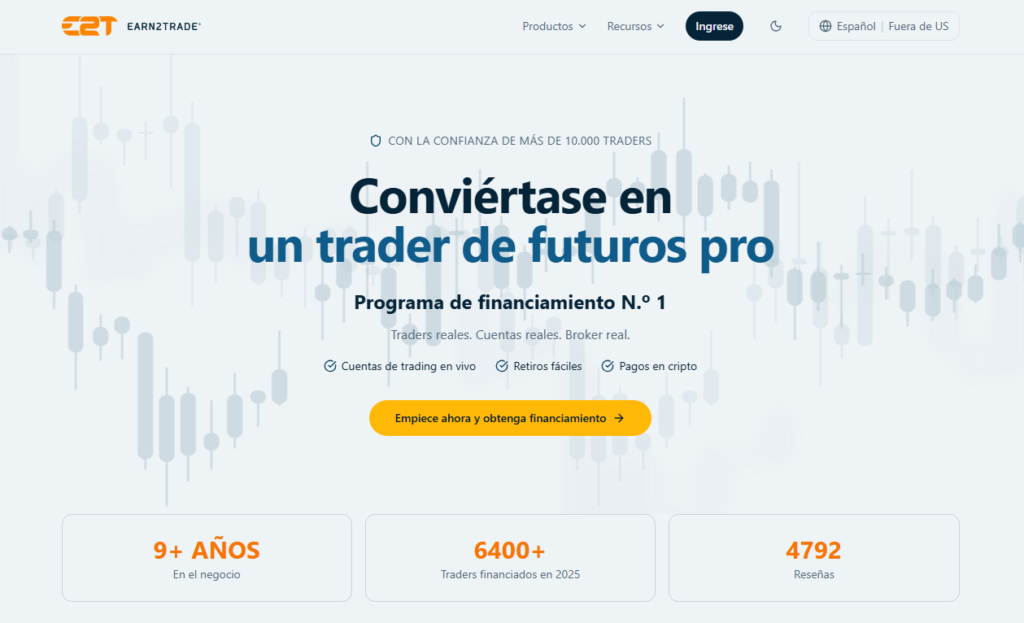
- Earn2trade Review
- More information: www.earn2trade.com
The big advantage: accelerating the building of your personal wealth
Here's the interesting part, and this is where many people connect the dots.
The idea isn't necessarily to "always live off funding accounts." The idea is:
- You use funding to generate bigger returns faster.
- Cobras payouts.
- And with those payouts you feed your own capital.
It's that simple: if one year you withdraw, for example, 20,000 in payments from funding accounts, you could (hypothetically) take a large part, like 15,000, and put it into your personal investments or your personal trading account.
The result? You're building your wealth base much faster than if you were only relying on the initial small account.
And this logic, honestly, makes sense to many people.
The flip side of funding: the rules aren't a detail, they're EVERYTHING
Now, what isn't gold, and it's worth emphasizing because this is where most people fail:
Funding companies are not perfect. And not all of them are the same.
Investing in a company's capital comes with conditions. And many people choose a funding firm for reasons that shouldn't be the primary criterion:
- “A friend recommended it to me”
- “I saw a discount coupon”
- “TikTok says it pays quickly”
- “It’s the one that’s in fashion”
And then the problems begin. Because they didn't focus on what was important.
What conditions typically vary between funding companies?
It depends on each firm, but typical examples are:
- Daily drawdown limit (maximum loss in one day)
- Total drawdown limit
- Rules for trading news (whether or not you can trade during major events)
- Inactivity Rules
- And, in general, the complete framework of how you should operate
This matters because a strategy can be excellent in a personal account… and simply incompatible with a funded account.
And not because the strategy is bad. But because the rules force you to operate differently.
So, before paying for an evaluation, the least you could do is sit down and think:
- Can my strategy withstand a daily limit?
- Do I need to hold trades during news events?
- Should I swing trade and leave positions open for days?
- Does my performance curve have bad spells where I would need margin?
If it's not a good fit, the "discount" doesn't matter. It's not the right company for funding.
So… how do I start trading? (without overcomplicating things)
If I had to turn this into a practical guide, it would look something like this.
Step 1: Be honest about your starting point (capital and expectations)
If you have 200, 500, 1,000, 2,000… perfect. You can start.
But understand this from minute one:
- If you're operating with a small amount of your own capital, your initial goal should be to learn, survive, and build consistency.
- If your expectation is to "live off trading in 3 months" with a small account, you're going to push yourself to overtrade and take ugly risks.
And that's where many break down.
Step 2: If your strategy is already solid, funding can accelerate the process
This is key. Funding is not a magic shortcut for people who still don't control risk.
But if you already have:
- clear risk management,
- reasonable consistency,
- discipline to follow rules,
- and a method you've already tested in a demo or real-world setting (even if it's small),
Then yes. Funding can be that "multiplier" that allows you to generate significant returns without having accumulated your own capital for years.
Step 3: Investigate the conditions, not the brand
I strongly emphasize this: do your own research.
Look at the terms and conditions. Compare. Read verified reviews. And above all, compare it against your actual way of operating.
Because this happens all the time:
- Someone chooses a brand because of the hype
- He doesn't read the news or the daily drawdown properly
- A normal day of volatility would take him out
- loses count,
- and concludes “funding companies are a scam”… and they’ll go cry on social media or Trustpilot.
And sometimes it's not that. Sometimes it was simply a poor choice for their strategy.
Step 4: Consider using both (if your profile allows it)
My honest opinion. You can try both options.
The idea would be:
- Funding companies to scale and generate capital faster, if you have the skill and can comply with the rules.
- Personal account to build wealth with maximum freedom, without depending on a firm closing you down due to some rule.
Because there is another very real point: if you depend 100% on funding accounts and you go through a bad streak, you can go from being funded with 200k, 300k, 400k… to being at zero and having to start all over again.
And that, psychologically, hurts (a lot).
On the other hand, if you are building your personal account at the same time (with payouts, with savings, with whatever), you are not totally exposed to a single "model".
A simple way to look at it (without so much fuss)
To sum it up in one sentence:
- Own capital: more freedom, but slower growth at the beginning if you don't have much money.
- Funding: more capital and faster income potential, but with strict rules and the need to choose well.
Look at it from a practical perspective, like this:
- Take advantage of funding if you can already be consistent and comply with rules.
- Use some of those profits to fund your broker account.
- Build your personal "base" while using funding.
It's not the only way. But for many people, it's the most sensible.
Typical mistakes when choosing between funding and equity (so you don't make them)
I'm going to make this clear, because it's repeated too often.
Mistake 1: Going with a funding company without having risk management
If you still can't respect a stop-loss order, if you take revenge on the market, if you use a martingale strategy when you get frustrated… a funding account is going to blow you up quickly. The rules don't forgive.
Mistake 2: Choosing a funding company based on recommendations without considering your strategy
Your friend can scalp quickly, while you swing trade. Or he avoids news, while you live off the news. It's not the same thing.
Mistake 3: Believing that small equity capital is “useless”
It isn't. It just won't give you a salary (at least not in the short term). But it can give you something that's worth more at the beginning: real skill without external pressure, and a smoother learning curve.
Mistake 4: Doing everything on one side
100% funding leaves you vulnerable to losing accounts.
100% own capital, a small amount can be frustrating due to the slowness.
For some, combining them solves many of those problems.
Conclusion: So which one should I choose?
If you're starting from scratch and your priority is to learn well, having your own capital (even if it's small) gives you control, freedom, and room to make mistakes without external rules.
If you already trade consistently and want to accelerate results, funding can give you access to large capital and help you build your personal wealth faster, provided you choose a prop firm that matches your style and respect its conditions.
And if you can do it, a mix is usually the smartest approach. You use funding as the engine, and your own capital as the foundation.
Ultimately, the question isn't just "what's best." The real question is:
Which route best fits my way of operating and my life, right now?
There's the answer. It's not usually the same for everyone.

My name is Norberto. I've been investing and trading for over a decade. I'm also the author of the trading course Experiencia Topstep. If you want to learn how to invest and have any questions, feel free to contact me.
You might also be interested in
HOW TO START INVESTING IN THE STOCK MARKET?

ARE FUNDING ACCOUNTS A SCAM? (HOW TO DISTINGUISH THEM)
Are funding accounts a scam? 9 signs to spot it
TRICKS THAT CAN HELP YOU FUND YOUR BANK
10 tricks that actually work to get you funded