In this article, we will explore the inspiring story of Ronald Read (Ron), a janitor who, through investing in stocks, managed to accumulate a fortune of $8 million.
His life is a testament to how perseverance and the right investment strategy can lead to financial success, regardless of where you're starting from.
Article summary
- Ron Read began investing in his 30s and maintained his strategy for over 60 years.
- Their focus was on high-quality companies and maintaining their investments for the long term.
- Despite his wealth, he lived frugally and dedicated his fortune to charity.
- Morgan Housel and the psychology of money.
A humble beginning
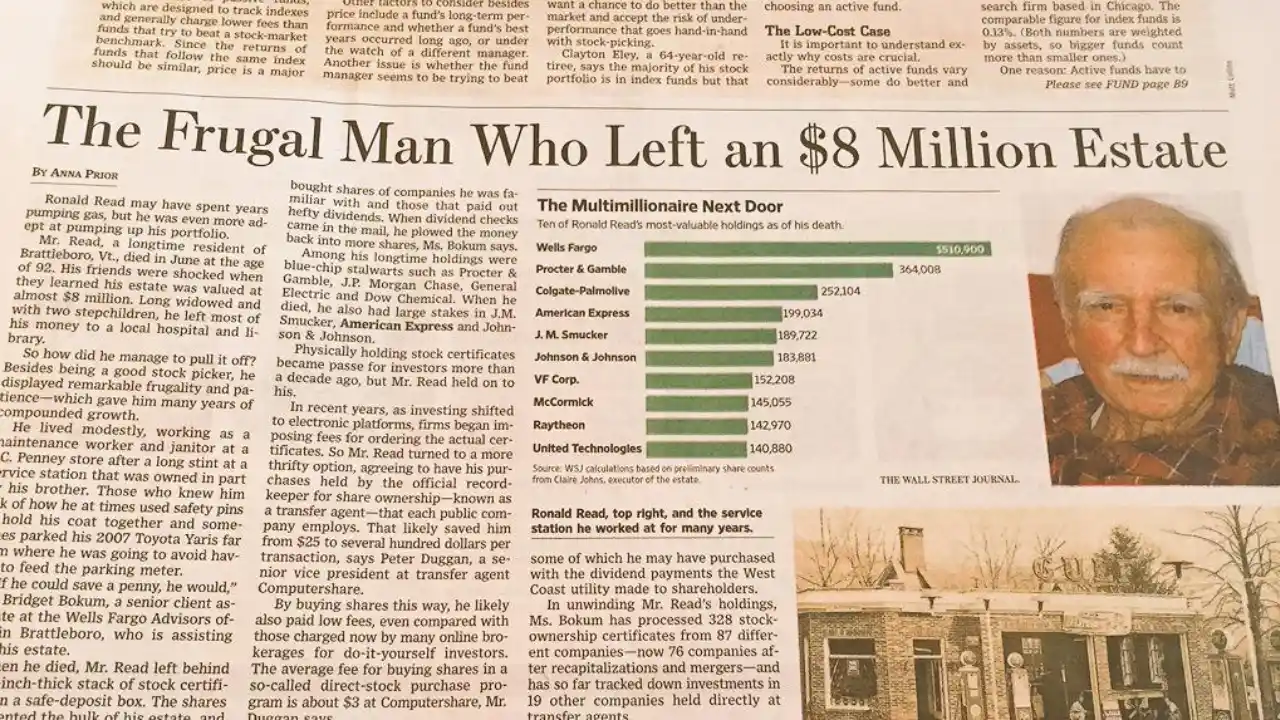
Ronald Reed was born in 1921 on a Vermont farm during a time of economic hardship. He was the first in his family to graduate from high school, walking four miles daily to attend classes. After serving in the army during World War II, he worked as a mechanic at his brother's gas station.
Life as a janitor
After retiring, Ron felt bored and decided to work part-time as a janitor at JC Penney, even though he was already a millionaire. He often wore worn-out clothes, leading some to believe he was homeless.
Ron's Investment Principles
- Understanding the Business: I only invested in companies I could easily understand.
- Predictable Revenue: I was looking for companies with stable and predictable revenue.
- Solid Dividends: It focused on companies that offered consistent dividends.
Ron didn't have a college degree or Wall Street connections. His financial education came from reading publications like the Wall Street Journal. Throughout his life, he invested in solid companies, maintaining a portfolio that reached a value of $8 million by the end of his life.
Ron's strategy was simple: to be consistent in his investments regardless of market movements. This can be done very easily today via a Robo Advisor or an ETF. The truth is, you don't need any more knowledge than Ron had to do this (in fact, it's even easier for you, since regular contributions can be scheduled through the broker).
The importance of patience
Ron maintained his long-term investment, ignoring market fluctuations. Despite declines in his portfolio, he never panicked and continued investing.
A frugal lifestyle
Despite his financial success, Ron lived frugally. He didn't take vacations, wore worn-out clothes, and drove a Toyota Yaris. His scarcity mindset, forged in his childhood, led him to live below his means, even when he was a millionaire.
Philanthropic legacy
Upon his death in 2014, Ron left his fortune to various charities, hospitals, and libraries. Although he did not enjoy his wealth during his lifetime, his legacy lives on through his contributions to the community.
You can do the same thing Ron did
It sounds like something out of a movie, and it is. But the truth is, there's nothing extraordinary about what Ron did; in fact, you can do the same thing, and much more easily. Today, there are tools that allow you to invest long-term with just the click of a couple of buttons. One of the best assets for doing this is ETFs (What are ETFs?).
Investing in ETFs is much simpler than investing in stocks. My suggestion is that you create an investment plan. Here's a step-by-step guide on how to do it.
Our relationship with money
Ron Read 's story teaches us that it's not about how much money we earn, but how we invest it. I'm sure you wouldn't have waited until you died for your family and friends to find out you had $8 million.
Our relationship with money is more complex than it seems. Often, it's not just about how much we know or how hard we work, but about how we behave and how our emotions influence our financial decisions.
When we talk about money, it's easy to think it all boils down to numbers and formulas. But everyone's personal history plays a crucial role. Every experience we've had with money, from childhood to adulthood, shapes our relationship with it.
In his book 'The Psychology of Money: How the Rich Think', Morgan Housel tells us that it's not just about making money, but about how we manage it and what decisions we make.
Among the main lessons that Morgan Housel offers us in his work, the following stand out:
Pay the price
When we want something, like a new watch, we have to be willing to pay the price. In the world of investing, this means accepting volatility. If you want high returns, you must be prepared to face significant drops in your portfolio. For example, if you had invested in Netflix ten years ago, you would have seen huge ups and downs. The key is having the resilience to stay strong during market downturns.
It's never enough
Envy is a powerful motivator in our capitalist society. Often, even those who earn significant sums can feel dissatisfied when comparing themselves to others. For example, a doctor earning $500,000 a year might feel inferior to a CEO earning $10 million. This comparison can lead to unwise financial decisions, such as risking what one already has to acquire what one doesn't need.
Madness is in the eye of the beholder
Financial decisions may seem irrational from our perspective, but everyone has their own story and circumstances. For example, low-income families often spend more on lottery tickets than high-income families. This may seem crazy, but for them, it's a way to dream of a better life. Recognizing these differences helps us understand that not all investment approaches are right for everyone.
Peek-A-Boo
Unexpected events, such as the Great Depression or the COVID-19 pandemic, are examples of 'Black Swans'. These events are difficult to predict and can have a significant impact on markets. Rather than trying to anticipate these disasters, it is more effective to prepare for them mentally and financially. History shows that those who prepare for the unexpected usually come out on top.
The allure of pessimism
Human nature tends to focus more on bad news than good. This is because losses often have a stronger impact than gains. Therefore, it's crucial to be aware of this tendency and not give in to pessimism. History and progress often require a long-term perspective, and it's important to remember that the world is better than we sometimes think.
Morgan Housel's practical tips for improving your finances
Tips for investing wisely
When it comes to investing, patience is key. Here are some tips I've learned from Morgan Housel:
- Start early: The sooner you start investing, the more time you'll have for your money to grow.
- Diversify: Don't put all your eggs in one basket. Invest in different types of assets ( ETFs are an excellent product for diversifying your investment portfolio).
- Stay calm: Don't let your emotions control you. Impulsive decisions can lead to losses.
How to plan for the future
Planning is essential. Here are some steps you can follow:
- Set clear goals: What do you want to achieve with your money? Define your objectives.
- Create a budget: Keep track of your income and expenses. This will help you save more.
- Review and adjust: Your plan should be flexible. Review your finances regularly and adjust as needed.
The importance of patience in finance
Patience is essential in the financial world. Here are some reasons why:
- Time is your ally: Investments tend to grow over time. Don't despair if you don't see immediate results.
- Learning from mistakes: We all make mistakes. The important thing is to learn from them and move on.
- Building wealth takes time: Don't expect to become rich overnight. Wealth is built little by little.
Conclusion:
Ronald Reed 's story is certainly inspiring; however, I doubt any of you reading this would have done the same. The truth is, investing is important, and even more important is knowing how to invest and understanding the reasons behind our choices.
I'm not Ron Reed, and you probably aren't either. I say this because I want you to know that what Ron did worked for him, given his history and relationship with money. But that's not your story.
When investing in the stock market, you should consider your own personal history, and particularly your goals, both short-term and long-term. Based on all of this, you can choose different ways to invest. Investing with your children in mind will not be the same as investing to protect yourself from inflation.
Your investment goals will, to some extent, determine the strategy you choose.
The strategies I choose are: swing trading for the short and medium term, and a Robo Advisor for the long term (although an investment plan with ETFs could be just as good).
The long term is the simplest approach. I make regular monthly contributions, and the Robo Advisor rebalances the portfolio for me. It's a very conservative strategy, but the returns are small. There are no surprises with this strategy. I do this for my family; I don't intend to use that money myself.
Swing trading is different. The returns are higher, but so is the risk. You have to enjoy trading; otherwise, you won't be comfortable with this strategy. You can see how I swing trade on the Topstep Experience YouTube channel .
Regardless of your story, and what you end up choosing, the important thing is that you start, and the sooner the better.
Frequently Asked Questions
How did Ronald Read amass his fortune as a janitor?
Ronald Read became a millionaire by investing in shares of well-known companies and living very frugally.
What kind of investments did Ronald Read make?
Read bought shares in solid companies and avoided technology stocks he didn't understand.
What legacy did Ronald Read leave after his death?
He left more than $6 million to his community, including hospitals and libraries.
Why were people surprised by Ronald Read's fortune?
His friends and neighbors didn't know he was a millionaire because he lived a very simple and modest life.
What lessons can we learn from the life of Ronald Read?
We can learn about the importance of saving, investing wisely, and living below our means.
What did Ronald Read do before becoming a janitor?
Before becoming a janitor, he worked as a mechanic at a gas station for 25 years.
My name is Norberto. I've been investing and trading for over a decade. I'm also the author of the Topstep Experience trading course. If you want to learn how to invest and have any questions, feel free to contact me.
You might also be interested in
HOW TO START INVESTING IN THE STOCK MARKET?

INDEX FUNDS VS ETFs: WHICH ONE TO CHOOSE?
Explore the differences between index funds and ETFs.

THE BEST OPPORTUNITIES TO INVEST IN ETFs
In the world of investments, ETFs (Exchange Traded…