
 Norberto Viale

Investing in passive indexing has become one of the most popular and straightforward ways to manage investments. Inspired by influential figures like Warren Buffett , who recommends allocating 90% of one's inheritance to index funds and 10% to Treasury bonds, we see Ferran Font break down this strategy in the following video (I don't know if you know this, but Ferran was my mentor in trading and investing in the stock market).
Key resources from Ferran Font's video: Book, Code, and Assignment Model.
Giveaway of the book 'The Calm Investor' by J. Bautista.

Github code available
Screenshot of the code shared by Ferran Font:
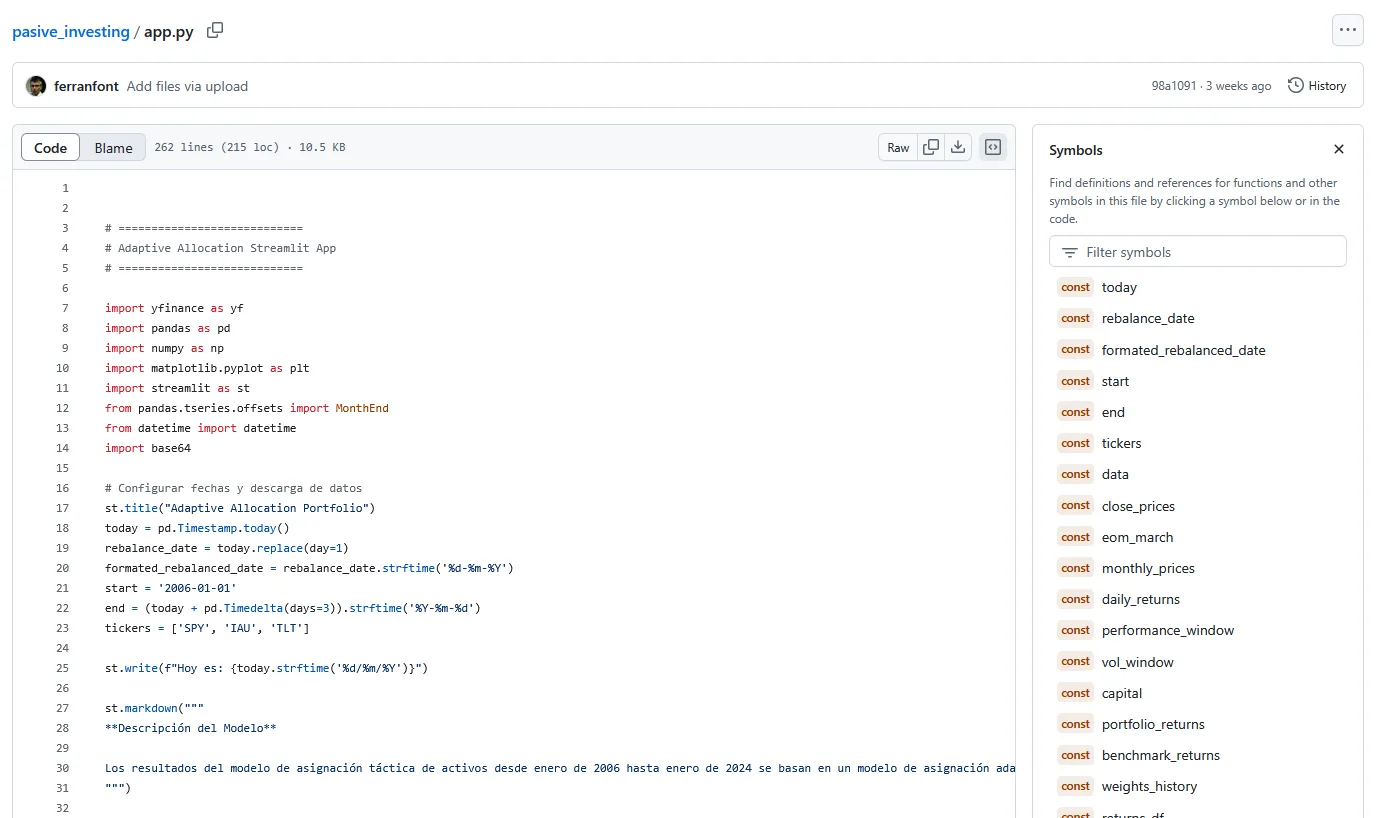
Adaptive Allocation Portfolio Model App
👉 Tactical asset allocation model from January 2006 to January 2024
Ferran Font's 'Order Book Trading' course
👉 Ferran Font's Order Book Trading Course
The IESE study cited by Ferran Font
👉 You can see the IESE study here
History of passive indexing
Passive indexing originated over 50 years ago when John Bogel, founder of Vanguard, revolutionized the investment world. His proposal was simple yet disruptive: replicate the performance of a stock market index instead of trying to outperform it through active trading. This approach eliminated the need for complex predictions and allowed investors to access overall market returns with a low-commission structure.
The model proposed by Bogel emerged in response to evidence that both institutional traders and professional fund managers rarely manage to consistently beat the market. Several studies support this claim.
For example, the research led by Pablo Fernández (IS associated with Harvard University) analyzed the profitability of investment funds in Spain since 2001 and yielded compelling data:
- Average negative return of -2.22% for actively managed funds.
- Only 29 out of 632 funds managed to outperform the average return of equities.
- Spanish government bonds offered an average yield of 5.8%, while institutional funds barely reached 2.3%.
These figures reflect the challenge even the most experienced managers face when confronted with a well-executed passive strategy. Passive indexing has thus established itself as an effective tool for the small investor and continues to gain popularity worldwide.
Philosophy and benefits of passive indexing
The core philosophy of passive indexing can be summarized in a simple principle: buy and hold. The goal is to replicate the performance of a stock market index, without attempting to anticipate market movements or select individual stocks. This strategy eliminates the need to predict the future, thus reducing the margin of human error.
One of the most significant benefits is access to low fees. Index funds and automated tools (robots) allow you to invest at significantly lower costs compared to traditional active management. Paying lower fees means more of your money works for you, increasing your net returns over the long term.
Studies such as the one conducted by Pablo Fernández demonstrate that the average return of actively managed institutional funds hovers around 2.3%. In contrast, investments based on passive indexing can achieve returns similar to or higher than the market with less operational effort and less impact from recurring expenses.
Effective strategies for investing in passive indexing
The key to maximizing the benefits of passive indexing lies in implementing smart strategies that respond to actual market conditions. One of the most highly recommended is the periodic rebalancing of equities and treasury bonds, adjusting the portfolio according to risk profile and economic expectations.
Dollar cost averaging (DCA)
- It consists of investing a fixed amount of money at regular intervals, regardless of the market price.
- This tactic reduces the impact of volatility and helps avoid impulsive mistakes caused by emotions.
- Example: If you invest $10,000 each year and the returns are reordered, you could end up with $60,000 less than if you had timed it perfectly. The order in which the returns occur has a greater impact than it seems.
Strategic rebalancing
- Taking advantage of automations like those offered by Indexa Capital or similar platforms allows you to modify your exposure between stocks and treasury bonds as your personal situation or the economic context evolves.
- Rebalancing can be done by manipulating your risk profile with periodic questionnaires, which modifies the proportion of assets in your portfolio.
Take advantage of key moments
- Buying during periods of uncertainty (such as war in Ukraine or inflationary spikes) can create unique opportunities.
- Selling some equities when there is widespread euphoria or complacency in the markets helps to protect gains.
- When bond interest rates are high, increasing their weight in your portfolio protects against stock market downturns.
The combination of these tactics allows not only maintaining an efficient passive strategy but also optimizing returns by actively adapting to the environment.
Conclusion
Passive indexing offers a simple and effective way to invest easily. This strategy allows you to sleep soundly at night without major worries due to its low-risk and diversified structure. The impact of tariffs and other economic factors may temporarily affect investments; however, the philosophy of maintaining a long-term perspective reduces these concerns.
Passive indexing provides:
- Consistent yields
- Low volatility
- Ease of management
By following strategies like dollar-cost averaging (DCA) and adjusting exposure according to market conditions, growth potential is maximized. Investing in this type of portfolio is a smart decision for those seeking long-term stability and growth.
You might also be interested in









Hi Ferran. I hope you're doing well.
As always, I never cease to learn and be amazed by your way of decoding the markets, and making everything easy to understand and grasp.
Thank you very much and a fraternal hug.
Ferran, while I'm still processing all of this, I find the specific idea of passive indexing very attractive and interesting, especially when we add active management. Thank you for all the effort you put into the videos and especially the training, which is undoubtedly the main gateway to this exciting world of investing and trading. It's a pleasure to have found you on this path! You deserve all the success! A big hug! Gabriel.
Thanks for all the info Ferran, I've already taken your course, I'm still learning, cheers!
Thank you so much for sharing such valuable content! In my opinion, Ferran Font is the best mentor. He's amazing!