 Norberto Viale

Today I want to share a trading strategy that I quite like. This isn't to say it's the strategy I use most often (in fact, I don't use it since I trade using the DOM), but I believe it has potential and deserves to be tested. In this strategy, we'll only work with price and volume.
It's a simple strategy that aligns with my understanding of trading (here you can see my intraday trading strategy) and, moreover, has the advantage of adapting quite well to the Topstep (What is Topstep?), which makes it even more attractive.
In fact, this trading strategy that we will work on here is a simplified version of something that is used quite a lot in the Futures Trading course, and I say simplified because I will not develop many of the contextual elements that are applied in the school (at the Vicens Castellano academy, the market structure is very well explained based on very specific levels that will ultimately determine whether you should look for a long or a short position).
Today I'm only interested in showing you the market entry pattern, and it will then be up to you to apply it where you think best based on your experience and/or prior knowledge.
We will look for the entry point (or window of opportunity) where the price makes an upthrust, a spring, a double top, a double bottom, or a failure. We will call these movements 'reversal patterns'.
Here's an example of each of these 'turning patterns':
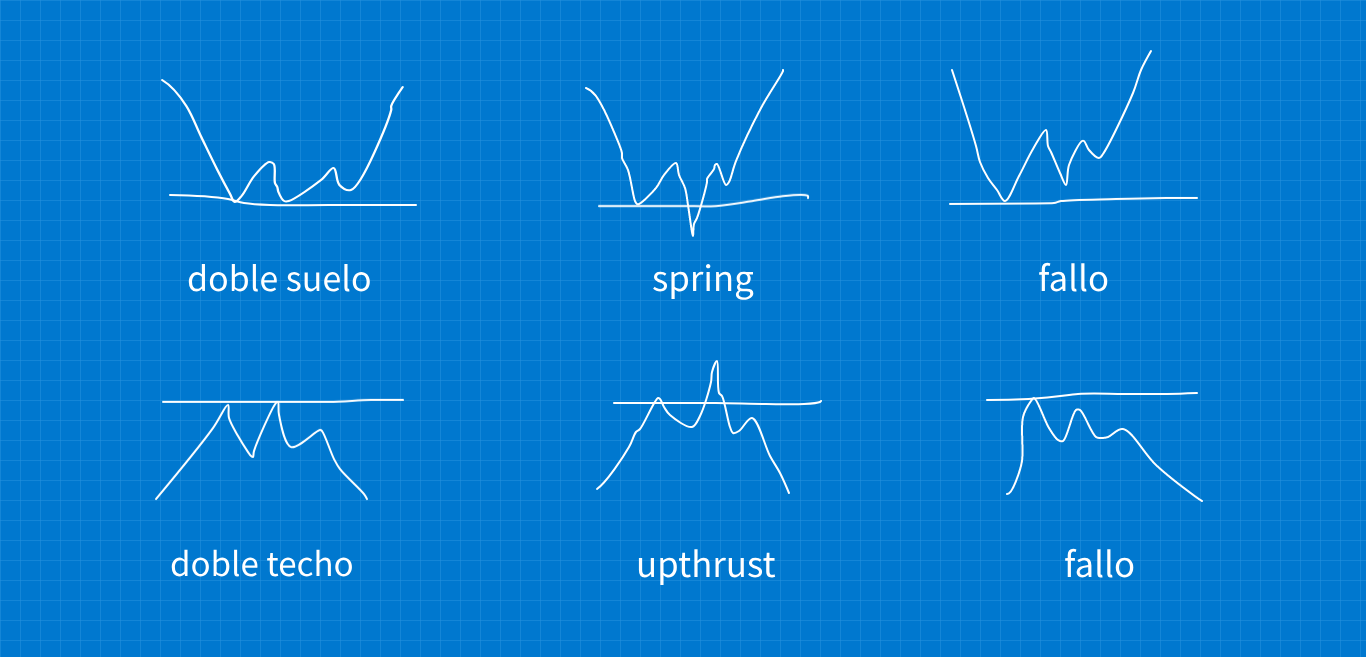
With the intention of simplifying my explanation, I will only work here with the reversal pattern when it shows us a window of opportunity that encourages the search for long positions (ultimately, if you want to go for a short position, it will be the same but in reverse).
Let's begin with a SPRING
So, the first step is to identify the overall market trend (this is where you'll do your market analysis, which will largely depend on your background). Once you've identified this trend, you'll look for a reversal pattern (any of those mentioned above) during a pullback that opens a window of opportunity to take your trade.
An opportunity window is not the trigger (the entry point). Its function is to alert you, letting you know that the current situation will most likely present an opportunity to pursue your trade, in this case, a long position. However, to enter the market, a condition must be met, and only if that condition is met will you enter. This condition is your trigger (if this trigger is not present, the opportunity will pass).
Your trigger will then be a candle in favor of the bearish movement (a red candle) where the volume shows a drop in relation to previous movements (remember that we are looking for a long position. We want to see little volume entering from the bears).
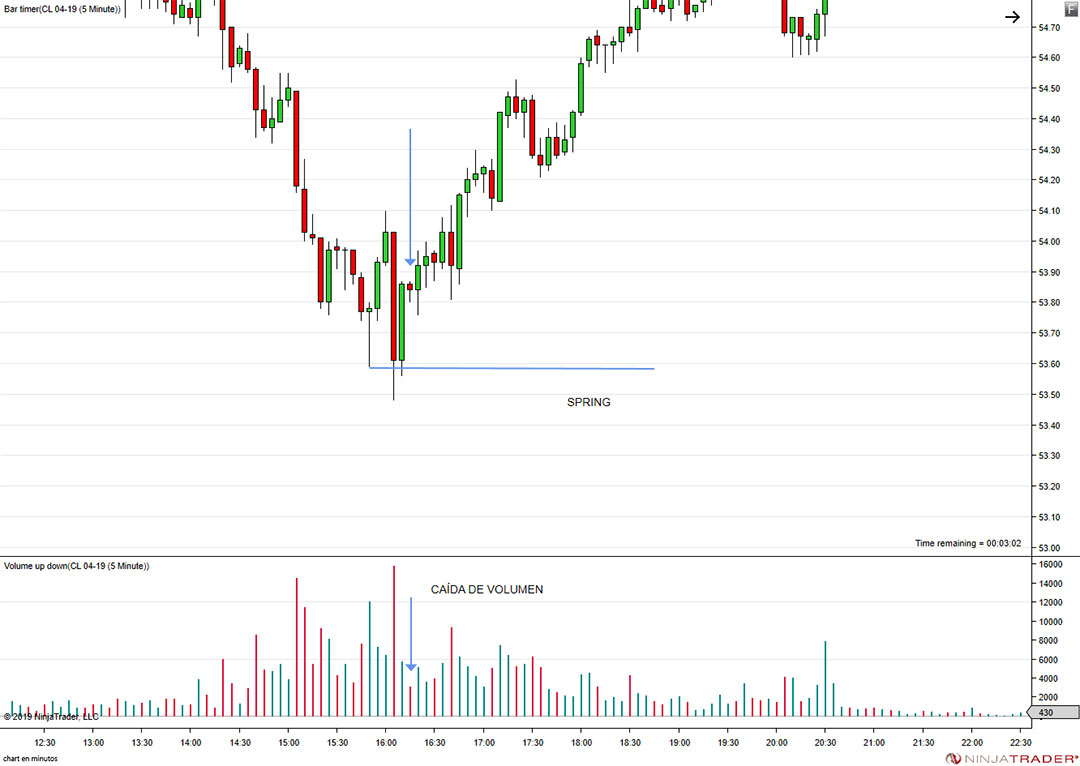
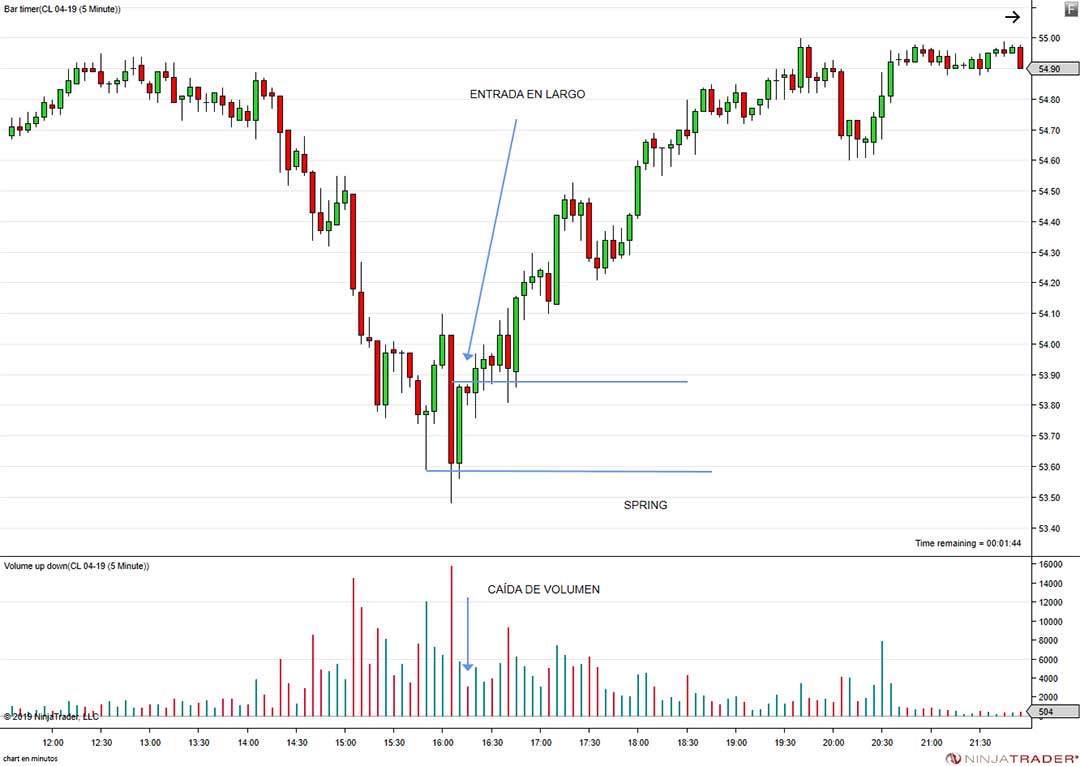
The long entry will be above the opening price of the red candle, which indicates a lack of volume and acts as a trigger. Always keep in mind that volume is relative; you should evaluate it in relation to the volume seen throughout the session.
Let's look at another example. Now with a DOUBLE FLOOR
Once again, the price is within an uptrend and is making a pullback. This pullback is where you'll look for your reversal pattern (pay attention to the volume details; only after this double bottom does the volume associated with the red candles begin to decrease, allowing us to clearly identify the drop. Since this example is taken from the European session on the CL, working with volume can sometimes be a bit more difficult due to the lack of movement, but it's not impossible, as you can see here).
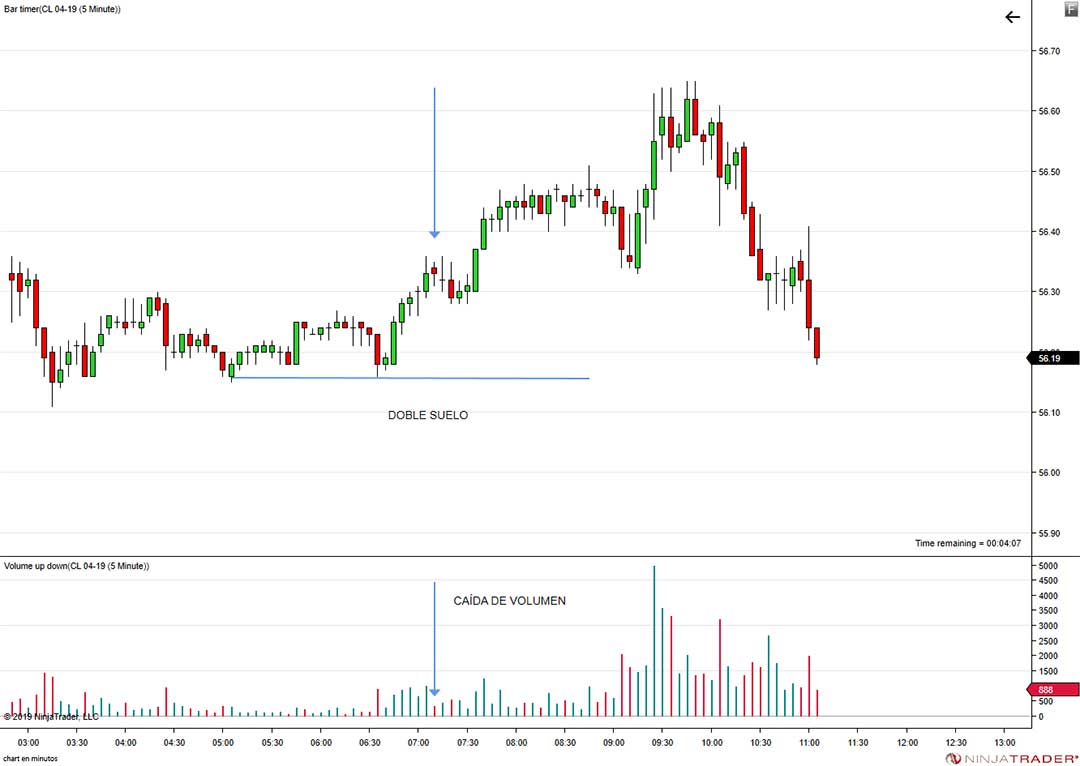
This reversal pattern, just like the previous example with the spring, is simply telling us that there's very likely an opportunity to go long. But to do so, I need my trigger; if I can't identify this trigger, I won't be able to take the trade (this is extremely important, don't forget).
Your trigger is again a bearish red candlestick with falling volume. In the following example, we see it clearly: there is no incoming volume in favor of the short move, so after the double bottom, you will place your order just above the opening price of the bearish candlestick that acts as the trigger (since this is a 5-minute chart, your order would only be executed 20 minutes later).
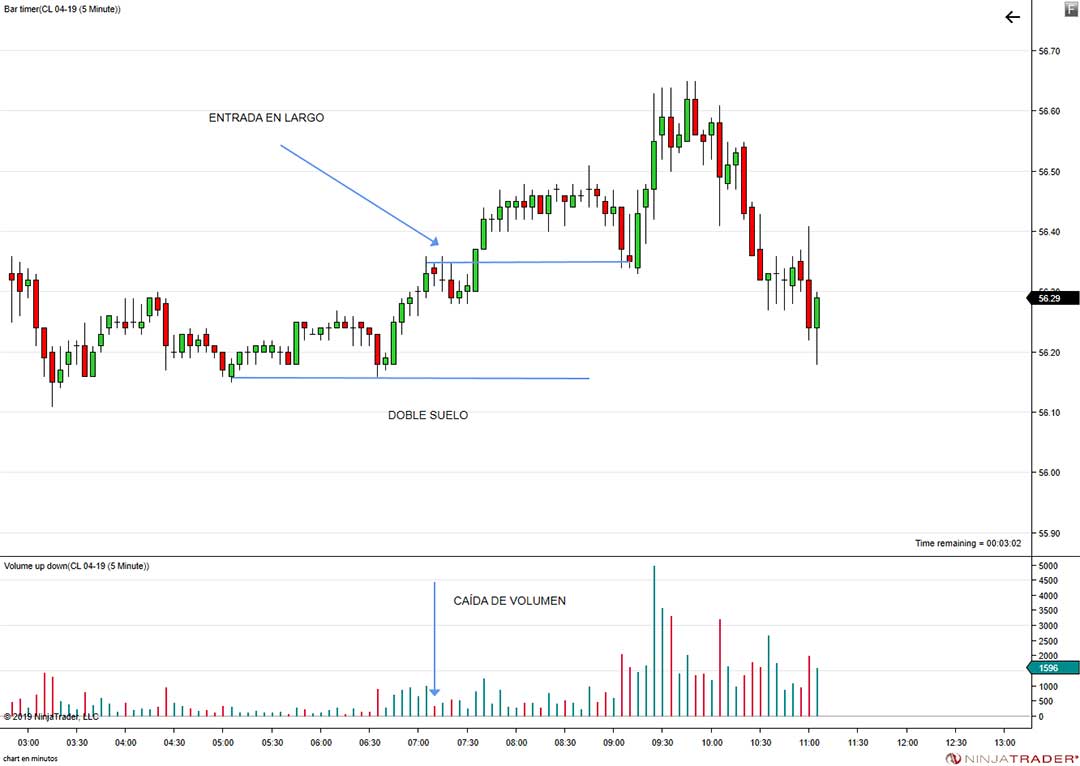
You understand what we're aiming for, right? If you had to put this strategy into a trading plan, you would probably outline the steps like this (note that a trading plan involves many more elements than we've mentioned here. This is just what it covers when entering the market):
- Was I able to identify the general market trend? (This is where you will put your prior knowledge into play in order to build your structure.)
– Yes -> Go to step 2
– No -> Wait
2. Am I in a pullback? (because you want to enter in the direction of the trend that determines your structure)
– Yes -> Go to step 3
– No -> Wait
3. Is there a turning pattern? (This is the window of opportunity.)
– Yes -> Go to step 4
– No -> Wait
4. Look for a trigger (your trigger is a candlestick with a volume drop contrary to the trend indicated by your structure)
Conclusion:
A strategy that can yield good results beyond intraday trading (it would be interesting to know how well it adapts to long-term trading with stocks).
It is definitely not a good idea to use this strategy and its entry pattern without some market context to frame it. Using this market entry strategy without context would lead to emotional trading, which is what we always try to avoid (if you want to know why emotional trading should be avoided, I recommend you read this article: trading and why winners win).
Ideally, you should combine this strategy with your buy-sell zones, which you can determine using a higher timeframe (often daily if you're day trading) or even with volume profile. Regardless of your structure, you can't trade without one.
However, if you're looking to refine your entry strategy, it's worth taking a look. When used correctly, it can yield significant benefits, especially when your risk-reward ratio is 3:1. People who use it in combination with a structured approach and target large positions report positive results even with a win rate of only 40%. It's definitely another option to consider, and I hope it helps your trading.
You might also be interested in