
 Norberto Viale

If you're here it's because you've read my article: 'Trading strategy with Topstep', if you haven't done so I recommend you do it.
Funded accounts like Topstep or earn2trade are shortcuts I recommend to those who are just starting out in trading, but we don't want to only trade via funded accounts.
I've already talked to you about Structure, 'Anomalies' and also Order Flow (you can see these articles in the trading strategies).
Each of these posts is another piece within this trading puzzle and they clearly do not work in isolation, even though when I share content I analyze each topic separately.
Today I'm trying to close the circle a little more and combine all these elements so you can see how I use them in my intraday strategy, knowing that reading the institutional intention is much more than just the sum of its parts.
This strategy goes beyond funded accounts because it exposes you to a larger stop loss, although you can always adapt what I show you to your own needs.
The strategy is based on the pillars that we have already worked on independently, and these are:
- Market Structure
- Anomalies
- Order Flow
- Risk management
These four elements should give you the possibility of putting the odds in your favor.
Trading and market structure
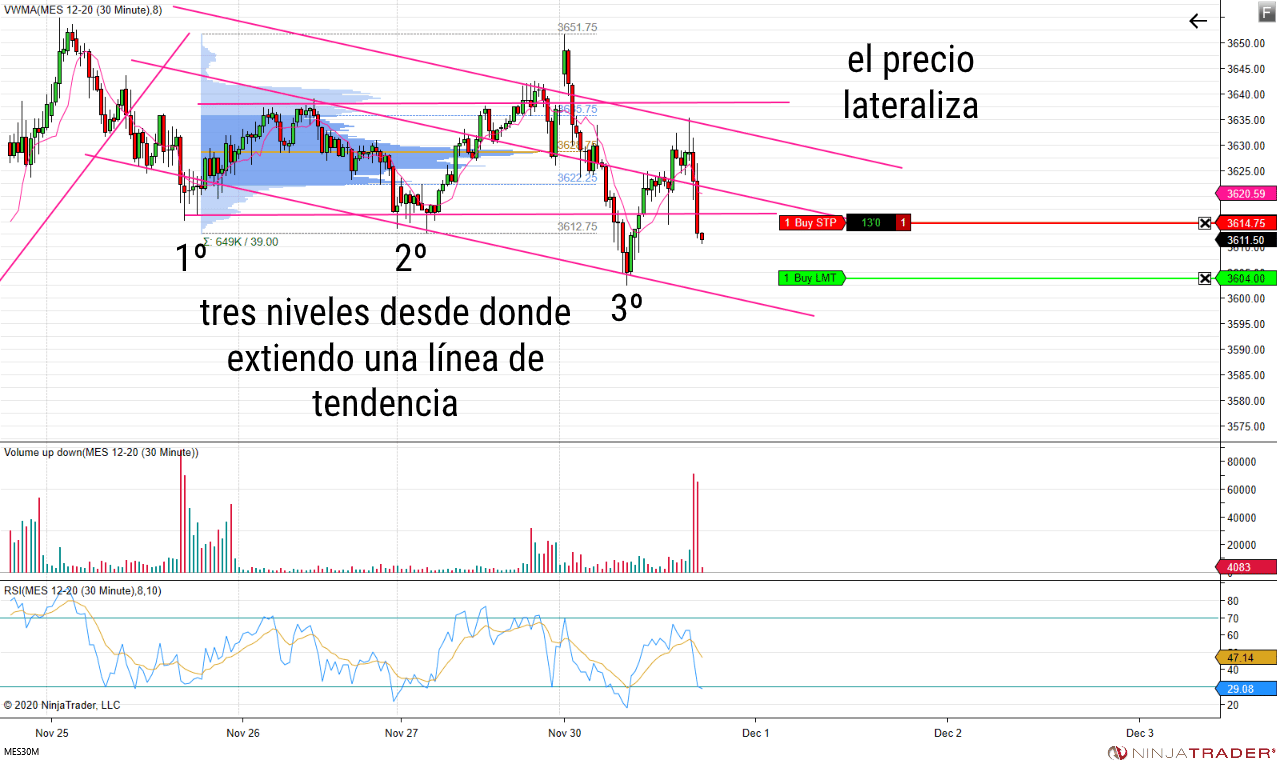
I work on the structure using a 30-minute timeframe . In intraday trading, a 30-minute timeframe allows me to see the most relevant levels quite clearly .
What I'll do is mark the horizontal support and resistance levels while also looking for signs of the prevailing trend . I elaborate on this topic in more detail in my article on 'trading for anxious traders'
In the example below, you'll see that the trend isn't strong. The price had just broken through an upward trend line and has since moved sideways.
However, I can identify three levels where the price finds support and draws a downward trend line that acts as support; this trend line will shape my structure.
To do this, I will extend it, seeking to make it coincide with higher levels that function as resistance (if it does not coincide, I will not have a structure).
Anomalies and confirmation in trading
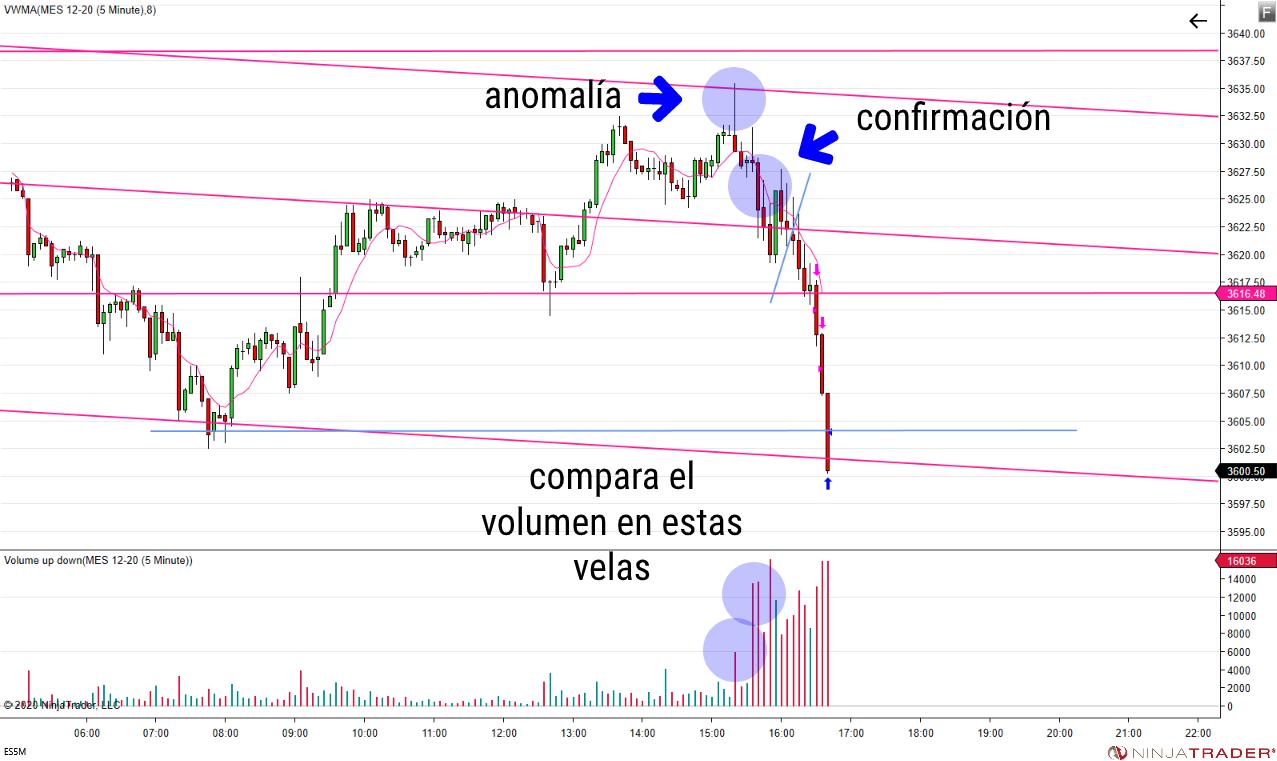
I analyze and confirm anomalies on the 5-minute timeframe (don't you know what an anomaly is in trading?). Since my structure is bearish, I'll limit myself to looking for short positions; therefore, my anomaly should appear below resistance.
Anomalies are analyzed within their context. An isolated anomaly may not mean much, but under resistance it is a clear sign that a shift may be imminent.
However, the anomaly is only the first sign; after that, you will have to wait for confirmation to be sure.
Extra signs of support
Both the anomaly and the confirmation are very important elements in terms of reading the institutional intentionality.
But these aren't the only signals you can look at. I personally also like to check if, after the 'confirmation', a Low Volume Area has been tested in the Volume Profile, if we're not selling above support, if there's a trend line break in a lower timeframe, or even if the RSI indicates 'momentum'.
If you are a Wyckoff , you might be interested in seeing a decisive creek breakout or a watchdog line, as Ferran Font often mentions in his trading courses.
As you will see, there is no shortage of signs, you just have to know how to interpret them (in this mini trading course where Ferran trades with the students you can see more about this topic, pay attention to how he calculates the target based on the work of the algorithms as well).
As you can see, there are many variables we're considering. That's why it's often so difficult to program a robot; machines struggle to 'see' everything the human eye sees.
Not all of these signals need to be present when you're looking for trades, but it doesn't hurt to have an extra element of confirmation. Seeing just one of these signals is enough for me, although they usually go hand in hand.
In the example I'm sharing, almost all of them are present.
Market Entry and Order Flow
Despite all the signals I've already mentioned, there's one I can't trade without. I'm referring to Order Flow (What is Order Flow and how does it work?).
In the Order Flow, what I want to see are market buy/sell orders pushing the price in the direction of my working hypothesis.
Remember that market orders move the price; limit orders can only stop it.
Always keep in mind that all these signals I'm talking about are part of a coherent whole. Price speaks a language that we try to decipher using different signals; it's the only way to understand it. However, in isolation, these parts don't tell us much.
Our goal is to determine the most likely move, but even with all these signs, we'll never be 100% certain. Uncertainty is the rule in this game.
I really like using Order Flow, but it's not essential, nor is it better than other ways of interpreting institutional intent. There are other methods; I'm just sharing the one I like and use.
The icing on the cake of trading: Risk management
Risk management is arguably one of the most important variables in trading , and yet it's something I've barely discussed in my previous articles.
As traders, we tend to focus heavily on the entry point, striving for a perfect one; however, this rarely happens. That's where the stop loss comes in, they'll tell you.
Clearly, if the working hypothesis is invalidated, the stop loss should be our last line of defense, not the first. How many times has it happened to you that the price hits your stop loss and then goes straight to your target?
This usually happens with those who use fixed stops. Many trading schools teach this; it's largely part of the marketing they use to sell courses.
They'll tell you that with a 5 or 10 tick stop loss, you can protect yourself from a bad trade and let your profits run if your working hypothesis is confirmed. This way, you'll make money just by being right 30% of the time. You lose $5 and win $1,000,000. I don't need to tell you that it doesn't work like that, do I?
Once again, Day Trading Academy (DTA) offers us an example of marketing that sells stock market courses.
Below is a screenshot taken from this trading school's website. Max stop loss 5 ticks (and if this doesn't convince you, look again, because they don't miss the opportunity to tell you that with 10 contracts the profit would be $2000).
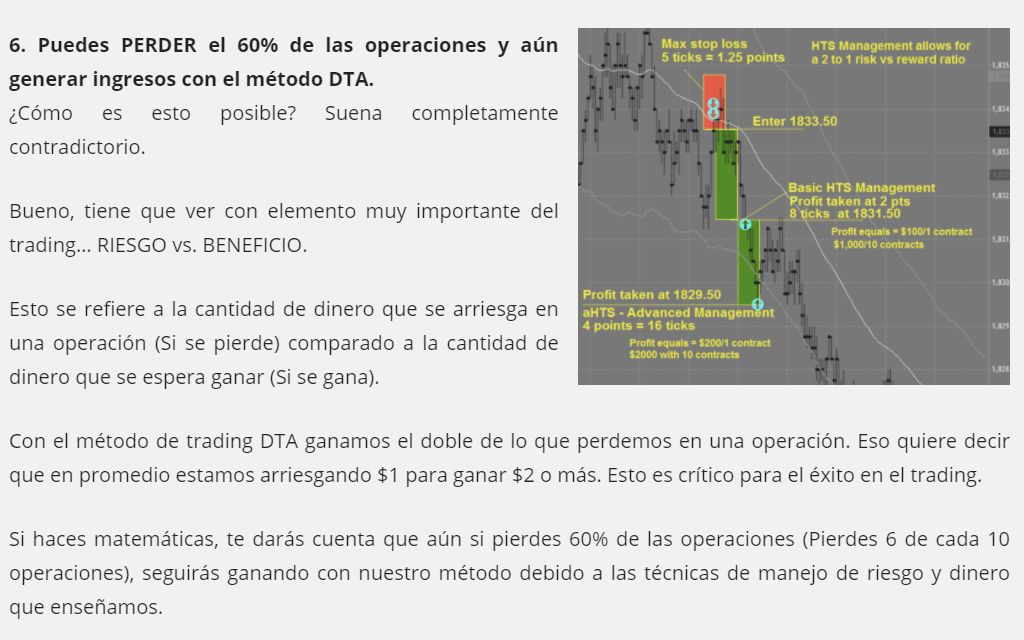
So, is it not possible to trade with such small stops? Actually, what I'm saying is that it doesn't work for me. I know some very good traders who trade with 14 or 15 tick stops and show consistency month after month (although 15 ticks isn't the same as 5). But these traders are rare.
The problem with having such a tight stop loss is that it will easily lead you to emotional trading. You'll try it once and your stop will be triggered; immediately the price will move in favor of your working hypothesis. Seeing what happened, you'll try it again, and again your stop will be triggered. However, the price action won't invalidate your working hypothesis, so you'll try it once more, and again the price will hit your stop.
This will not only wear you down emotionally but will slowly but steadily deplete your account.
In my opinion, the price needs to breathe. Not giving the price room to breathe undermines the mathematical odds in your favor.
When you open a trade, the probability of the price going up is 50% and the probability of it going down is also 50%. But you know that the price doesn't move in a straight line but rather in a 'zigzag' pattern. By placing your stop loss at only 10 ticks, all you achieve is significantly reducing the statistical probability of a 50% win while increasing the probability of getting caught in this zigzag.
As I always say, every trader is unique, and what works for me might not work for you. Here, I'm sharing what works best for me, and what works best for me in terms of risk management is having a wide stop loss.
Depending on the market you trade, a large stop loss may not be in your plans.
Holding a 30-tick stop loss in Micro Futures one in Mini Futures (it's approximately $40 in the former and $400 in the latter). Since my capitalization is small, I trade in markets where the risk is low (Micro Futures).
Risk measured in ticks depends on the market you're trading and the day's volatility. The S&P 500 is not the same as the Nasdaq. In some markets, 20-30 ticks will be relatively decent, while in others, 30 ticks will be very little.
Keep in mind, however, that the tick value on the NQ is almost half the tick value on the ES, so a larger stop loss would not necessarily mean risking more money.
usually aim to have my stop-loss protected by a previous high or low. To achieve this, I often extend my stop-loss to 30, 40, or even 50 ticks. The risk-reward ratio is often 1:1. This doesn't mean you should always wait for your stop-loss to be triggered.
As I said before, the stop should be your last line of defense, so if you consider the trade lost beforehand, close it (I usually look at the Order Flow for this; if there is a massive influx of market orders in the opposite direction to my working hypothesis, I close it).
I can do this because I trade E-Micro Futures. In the MES (Micro E-mini S&P 500), with just one contract, this translates to a risk of approximately $40 per trade (with two contracts it will be $80, with three $120, etc.).
However, when the price moves 20 ticks in my favor, I look for a pullback that gives me the opportunity to add a second contract to my winning position.
If the trade is successful, I can make a decent profit from the market (by "decent" I mean a figure close to $100. Believe me, it may seem small, but it adds up over the course of the month). This way, I can somewhat compensate for having such a wide stop-loss order.
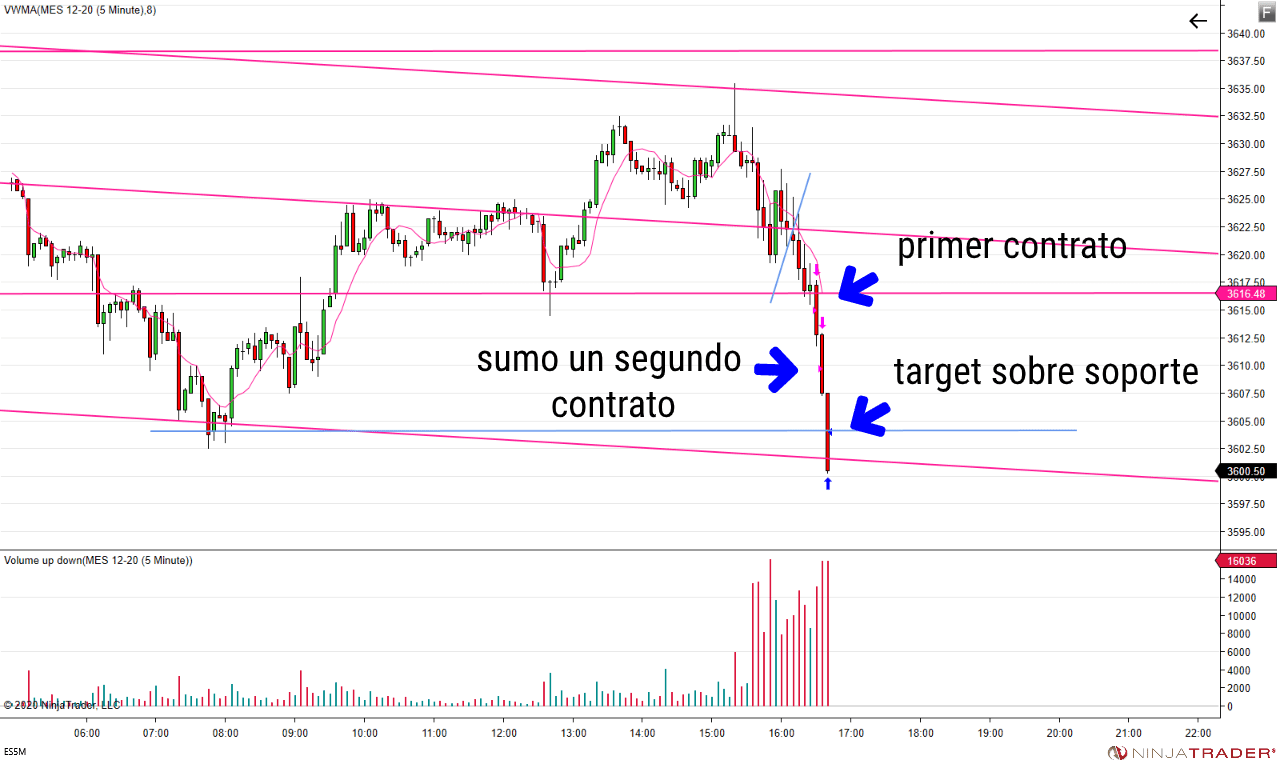
The worst-case scenario would be that the trade never moves in the direction of your working hypothesis and you end up losing 30 or 40 ticks. Fortunately, you'll only have one contract in (trust me, it's better for your mental health to lose just one 40-tick trade than three 15-tick trades).
If in your next trade you manage to add a second contract to your winning position, you can recover and come out ahead.
But pay attention here, I add the second contract when the operation is clearly winning (it's not a Martingale), in this way the first contract compensates (or sustains, we could say) any possible pullback to which the operation executed with the second contract is exposed.
Once I enter into a second contract, I never allow the two contracts to expose me to a negative outcome, ever.
The position must remain positive at all times; otherwise, I'll close something else. If you'd like to delve deeper into this topic, you should read my article: 'The best YouTube videos on risk management in trading'.
Having this type of stop makes this strategy not fully suitable for the tests of funding companies.
If you trade with Topstep, you will most likely want your stop loss to be no more than 20 ticks and you will take profits more quickly (particularly with those companies that measure trailing drawdown in real time during the test such as earn2trade or Uprofit Trader).
But as I've already mentioned, funding companies are just a starting point. Eventually, you'll need to develop your own trading system , free from constraints. A system that suits your personality and lifestyle—basically, a system that goes beyond Topstep. Today, I'm sharing mine with you.
WHERE TO STUDY TO INVEST IN THE STOCK MARKET?

THE BEST STOCK MARKET COURSES FOR INVESTING IN STOCKS











I read all the articles, and I've learned a lot for my intraday trading, thank you
Hi Marco,
I'm glad to hear they were helpful. I always try to share what's worked best for me… but I'm still learning every day. Let's keep in touch 😉
Greetings