You've probably already experienced it. Or you're about to.
You sign up for a funding test, make your plan, open the chart with that strange mix of excitement and fear… and at some point, something breaks. It's not always a bad trading idea. Sometimes it's a small, repeated, cumulative mistake. And by the time you realize it, you're out. Reset. Another fee. Another attempt.
The frustrating part is this: many people fail not because they "don't know how to trade." They fail because they don't understand what a funding test is actually evaluating.
It's not an IQ test. It's a test of consistency, risk management, and adherence to rules under pressure. And yes, it sounds simple. But it isn't when your money is on the line, when you have two days left, when you're 0.3% away from your target, when you've just hit two consecutive stop-losses and you're itching to trade.
Let's talk about common mistakes. The ones that are repeated time and time again. And how to avoid them without complicating things.
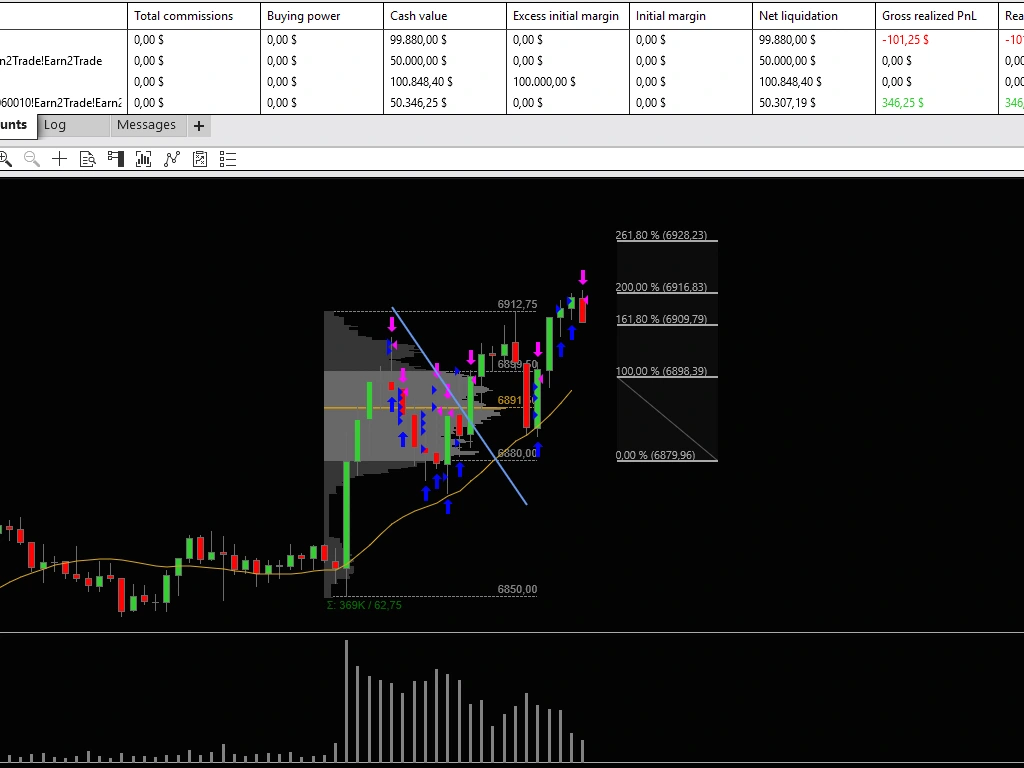
Example of operations using Earn2trade funding
1) Go to “do the target” instead of going to run a system
This is the father of them all.
You enter a test with a number in mind. 8%, 10%, whatever. And your mind starts translating it like this: "I have to win X in Y days." It sounds innocent, but that thought pushes you to force trades.
And the market senses that. You do too, but it's too late.
How to avoid it:
- Change your internal goal. Don't "hit the target." Your goal is to execute your process 20, 30, 40 times cleanly.
- Define in writing what constitutes a valid transaction for you. What it confirms, what it invalidates, what the schedule is, what the structure is. If it's not there, it doesn't exist.
- If there's no trade one day, there's no trade. End of story. The trial doesn't pay you for being active.
A helpful phrase: the target is a consequence, not a task.
2) Increase risk after a winning streak (or after a bad one)
Two versions of the same poison.
Version A: You won 3 trades in a row. You feel "on fire." You increase your lot size "just a little." And then, the inevitable losing trade hits. You make a big win and give back your profit.
Version B: You lost two in a row. You go into "recovery" mode. You increase your risk to get back to where you were. And that's when accounts get blown up.
How to avoid it:
- Set a risk per trade and don't trade it. 0.25%, 0.5%, 1%. The number doesn't matter. Consistency does.
- If you're going to escalate, do it systematically and in stages. For example: I only increase risk if I close 10 trades and the curve is stable, and even then, I only increase by a small amount.
- In a long-distance race, it's generally best to err on the side of caution. It's better to take longer and stay alive than to rush and die quickly.
This sounds boring, yes. But boredom is the friend of stagnation.
3) Not fully understanding the allowed drawdown (and playing with fire without realizing it)
Many people think, "I have a maximum loss of 10%," and that's it. But there are almost always nuances.
Some firms have specific maximum loss rules:
- daily loss .
- Max total loss.
- Sometimes the calculation is based on the initial balance, sometimes on equity, sometimes it's trailing (it moves with your earnings).
And that difference changes everything. Because you can be "winning" and still violate a rule for a spike in equity.
How to avoid it:
- Read the rules PDF as if you were gambling on a contract. Because that's what it is.
- Write down your exact numbers: What is my daily loss in money? What is my total loss in money? Is the limit based on equity or balance? Is it trailing? How long will the trail last?
- Set alarms. Literally. One alarm when you're at 50% of your daily limit. Another at 70%. Because when you're drunk, you don't think straight.
Most disqualifications aren't due to bad strategy. They're because "I went too far for no reason.".
4) Operate as if the test were your personal account
This mistake is subtle.
In your personal account you can afford to:
- to hold on a little longer,
- not putting a stop sign (serious, but it happens),
- average,
- to operate news because “sometimes it comes out”.
In a test, those "freedoms" will kill you. Because the rules are designed to eliminate precisely that kind of behavior.
How to avoid it:
- Treat the test like a job with daily auditing.
- If you can't justify it with a rule, don't do it.
- If your actual trading style includes prohibited practices (for example, holding trades on news events or swing trading with gaps), then it's not that "the signature is bad." It's that the test isn't suitable for you. It's best to know beforehand.
The test is not the place to improvise. It's the place to prove that you've stopped improvising.
5) Not having a limit on daily trades (and overtrading)
That's how it goes.
You start well. One win. You feel productive. You take another. Then another. One goes wrong. You want to compensate. You take another. And suddenly you made 8 trades in a day where your system normally gives 1 or 2 good setups.
Quality falls. Speed increases. And hidden risk emerges.
How to avoid it:
- Set a daily maximum number of trades. 2 or 3 is usually more than enough.
- Set a daily maximum loss limit. For example: 2 stop losses and that's it for the day.
- If you earn money early, you can also take a break. There are days when it's best to "save the day." Not out of fear, but for efficiency.
It's not a lack of ambition. It's statistical survival.
6) Entering out of FOMO when you see that "he left without you"
This is a classic in indices and forex.
You see a perfect impulse… that's already run. You tell yourself, "If I enter now, it might continue." You enter late, with a large or poorly placed stop-loss, it takes the normal pullback, and then, yes, it continues. Without you.
And it hurts. And it leaves you wanting revenge.
How to avoid it:
- Define a rule: if the move has already gone more than X points/pips from your zone, don't chase it.
- Practice letting go. Literally, as a skill. A lost trade because you didn't enter is a non-event. A lost trade due to FOMO is real damage.
- Have second-chance setups. Pullback, retest, break with confirmation. Something. Because the brain needs to feel that there's still a plan.
The market always gives you another chance. Your bank account doesn't always give you another opportunity.
7) Placing stops where they “feel good” instead of where they make sense
A stop-loss order isn't meant to minimize your losses. It's meant to invalidate your idea.
In mooring trials, out of fear of losing, people set microscopic stop-loss orders. They trigger them due to noise. They re-enter. They trigger them again. And they burn through their daily limit without having actually been wrong.
How to avoid it:
- Define the stop by structure, not by emotion.
- Adjust the position size to the stop, not the other way around.
- If the structural stop-loss is too large for your maximum risk, then that trade isn't for you. Don't "adjust" it. Leave it.
This alone greatly improves performance. And it reduces stress, which is also important.
8) Moving the stop to break even too soon (due to anxiety)
That's understandable. You want to protect. You want to feel in control.
But if you move the stop loss to breakeven as soon as the price moves even slightly, you'll get stopped out during the normal retest. And then it goes to the target without you. You're left with nothing, but mentally you feel like you've lost it. Because it was your trade and you "had it in the bag.".
How to avoid it:
Define an objective management rule
- Move to BE only after the price breaks out of structure
- Move to BE after a certain risk multiple (1R, 1.5R)
- Move to BE after partial close
Accept normal market volatility
- Sometimes you'll be in a floating profit and then in a loss. That's normal. It's not a flaw in the universe.
If your system needs air, give it air.
9) Working junk hours (just because "you have time")
Interestingly, this mistake is made by very disciplined people.
You trade when you can. After work. At night. During off-peak hours. And then you wonder why the market is slow, the spreads are strange, and the movements are unintentional.
It's not that you can't trade outside of main hours. But it's more difficult. And in a funding test, you don't want "more difficult.".
How to avoid it:
- Identify your best 1 or 2 time blocks. London session, New York open, or the time when your asset moves cleanly.
- If you can't trade at those times, then adapt your trading instrument. Or your style. But don't force yourself to chase movement where there isn't any.
The test is stressful enough without having to choose the worst terrain on top of it.
10) Do not practice "defense mode" when you are near the boundary or the target
This is extremely important.
You're just 1% or 0.5% away from passing. And your brain is racing. You start seeing setups where there aren't any. Or you take more risks to finish today.
Or the opposite. You're close to your daily loss limit. And you keep trading "because I haven't touched it yet.".
Both scenarios end the same way. Badly.
How to avoid it:
Defense rules you must implement:
- If you are at X% of the daily limit, reduce the risk by half or stop trading completely.
- If you are X% away from your goal, reduce your risk and only take setups rated A+.
- Remember: passing a test isn't about proving you can do 10% in 2 days. It's about proving you don't break down when you're close to a goal.
Funding rewards self-control, not showmanship.
11) Changing strategy mid-test
Start with scalping. You lose. Switch to swing trading. Then watch an "ICT" or "SMC" video and do something else. Then go back to indicators. Then mix it all up.
You're not operating a system. You're looking for emotional relief.
How to avoid it:
- One methodology per attempt. If you're going to change, change between attempts, not within them.
- If you want to improve, do it in a demo or backtest, and when it's ready, take it to the test.
- Write your playbook. Even if it's simple. 3 setups, 2 management rules, schedules, and that's it.
Consistency first. Optimization later.
12) If you don't keep records, then you repeat the same mistake 6 times
Most people think they know why they lost. But they don't know for sure.
"It was the market." "They caught my stop-loss." "It was news." "It was strange.".
Sometimes, yes. But often the real pattern is more uncomfortable: you entered late, you traded while tired, you took too many risks, you used a setup B, you moved the stop loss without a rule.
How to avoid it:
Keep a minimal journal, not a novel
- input and output capture,
- reason for entry (setup),
- risk used,
- emotion of the moment (1 word),
- Did I follow the rules? Yes/No.
Every 10 trades, review
- What mistake is repeated?
- What ruler do I need to cut it?
You don't need to be a scientist. Just honest.
A simple plan to avoid failing due to silly mistakes
I've put together a very practical structure for you. It's not perfect, but it works.
- Low fixed risk (0.25% to 0.75% per trade)
- Maximum 2 trades per day
- Maximum 2 losses per day and the platform will be closed
- A+ setups only (those you can explain in 2 sentences)
- No price chasing
- Stop by structure and size by risk
- Quick journal at the end of the day
- Defense mode when you are near the target or the boundaries
If you do just this, you're already ahead of most people. Seriously.
Conclusion:
Passing a fundraising test isn't a test of bravery. Nor is it about "who can endure the longest." It's a test of obedience to your plan when your body wants to do the opposite.
And yes, it's frustrating. Because typical mistakes aren't technical, they're human. Impatience, ego, fear, revenge, boredom. Normal stuff.
The good news is that you can design systems to protect yourself from yourself. Simple rules, clear boundaries, and a trading style that doesn't depend on being inspired.
If you're about to make your next attempt, make it more boring. Slower. More repeatable. You'll feel like you're making less progress… until one day you look at the panel and you're still in, and that's a real victory.
My name is Norberto. I've been investing and trading for over a decade. I'm also the author of the trading course Experiencia Topstep. If you want to learn how to invest and have any questions, feel free to contact me.
You might also be interested in
HOW TO START INVESTING IN THE STOCK MARKET?

HOW TO PASS A FOOTING TEST (WITHOUT GUESSING)
The definitive method for obtaining a funding account

BEST BROKERS FOR FUNDING ACCOUNTS
Regulated brokers for your funded trading.