A trader is not just someone who trades in the financial markets. They are a person who has developed a specific set of skills, mindset, and discipline that radically sets them apart from other people.
What truly defines a winning trader? The answer goes far beyond financial gains. A professional trader thinks independently, validates their ideas through rigorous analysis, manages risk with mathematical precision, and maintains consistent execution even during losing streaks. They understand that trading is a business that requires years of learning, inevitable mistakes, and constant effort.
The differences between a winning trader and a losing trader are clear and measurable:
- Independent thinking vs. blindly following others' signals
- Realistic expectations vs. seeking guaranteed daily profits
- Systematic validation vs. operating by intuition or emotions
- Rigorous risk management vs. risking excessive percentages of capital
- Unwavering discipline vs. skipping operations or arbitrarily modifying the system
shortcuts to becoming a professional trader . It requires dedication, continuous study, and a willingness to get your hands dirty with backtesting, analysis, and constant testing. This article will show you exactly what you need to develop to cross the line between consistent winners and those who quit with empty accounts.
🏅 Top broker for trading
Always remember that no matter which broker you choose, you should always make sure that it is a regulated broker.
 Vantage
⭐⭐⭐⭐⭐
Vantage
⭐⭐⭐⭐⭐
Main Advantage:
💰 Offers its own funded account (depending on the country). Best option for trading with MT4/5.
Ideal for: Traders who want to trade Forex and cryptocurrencies.
Recommended level: 🟡 Intermediate.
Investment type: Trading derivatives (CFDs, Forex, Crypto).
Note: 9.5/10
Free Demo Account1. Independent thinking in trading
Thinking independently in trading is the first barrier between success and failure. When you start out in this business, the temptation to follow signals, copy strategies, or blindly trust market gurus is overwhelming. Professional traders reject this path.
The difference lies in asking yourself "why" something works, not simply "what" to buy or "when" to sell. This fundamental question forces you to understand the logic behind each trade. If you can't explain the reasoning behind your strategy, you're trading blindly.
Avoiding reliance on others means developing unique and personalized solutions. Two traders can analyze the same chart and arrive at completely different, yet equally valid, conclusions. Your job is to build your own framework based on rigorous analysis. In other words, develop your own trading style.
Validation becomes your best ally. It's not enough to have a brilliant idea about the market. You need to validate your trading ideas through:
- Extensive backtesting: Test your strategy against real historical data
- Walk-forward analysis: Evaluates whether your system maintains its effectiveness in out-of-sample periods
- Detailed record: Document each operation and its results to identify patterns.
This methodology protects you from false promises and allows you to build genuine trust in your trading system.
💬 Join the Experiencia Topstep Community on Discord
Focus on execution and management, no fluff. My trading strategy explained with examples.
🚀 Join the Discord2. Validation and testing of strategies
Backtesting it would have performed in the past. It's not simply about verifying whether an idea generates profits, but about understanding its behavior under different market conditions. When you backtest in trading, you uncover crucial metrics: maximum drawdown, win rate, and positive expected value.
Walk-forward analysis takes validation a step further. You divide your historical data into segments: you optimize your strategy in one period and test it in the next, "unseen" period. You repeat this process multiple times. This technique reveals whether your strategy has true robustness or if it's simply over-optimized for specific data.
To run these tests, you need professional tools. AmiBroker is one of the most powerful backtesting software programs, allowing you to program complex strategies and perform detailed walk-forward analysis. The quality of your results depends directly on the quality of your data. Norgate Data provides accurate historical data adjusted for stock splits and dividends, eliminating survivorship bias that distorts the results of many traders.
Validating your ideas through rigorous backtesting sets you apart from those who trade based on hunches or patterns without statistical foundation. I'm a bit more basic and I really like to test my strategies with funded accounts; it's not ideal, but it's always worked for me.
Click here to learn how to use the RSI in your trading strategy
3. Risk management in professional trading
Risk management separates the professional trader from those destined to lose their capital. Risking a high percentage of your account on each trade guarantees eventual ruin, no matter how promising your strategy may seem.
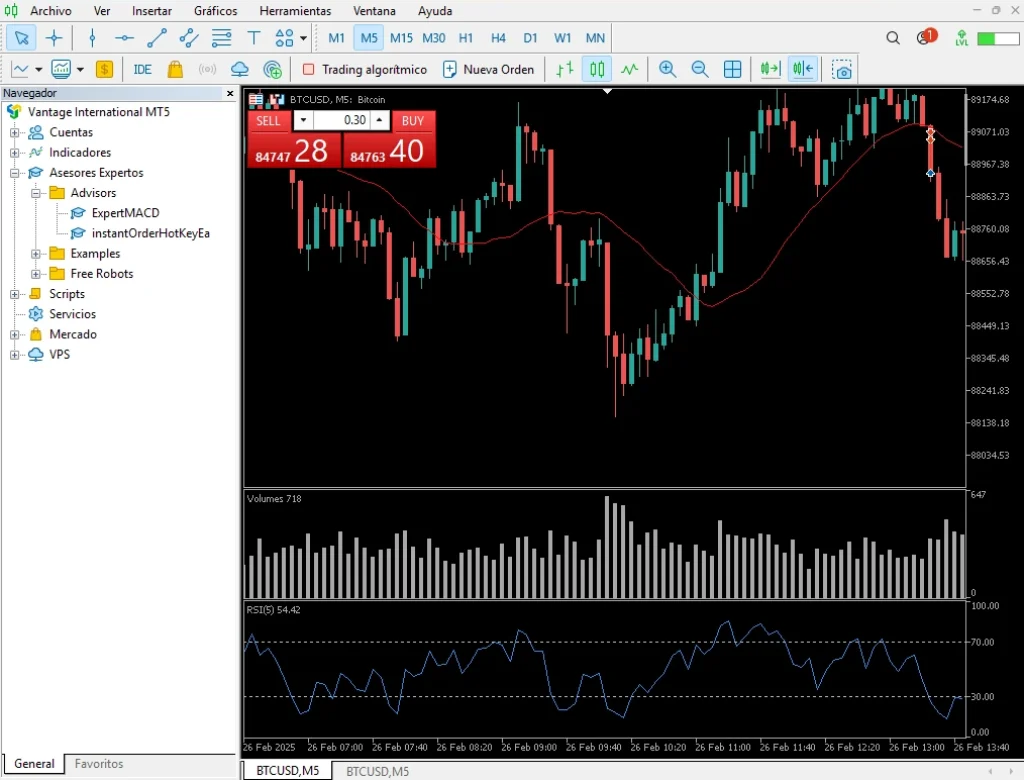
Trading with Vantage and Metatrader
Effective implementation of stop loss
The stop loss acts as your safety net. It defines exactly how much you're willing to lose before opening any position. It's not about placing arbitrary stops based on round numbers, but rather positioning them according to the asset's volatility and the market's technical structure. A stop loss that's too tight will exclude you from winning trades; one that's too wide will unnecessarily compromise your capital.
Leverage control
Low leverage protects your account from unexpected adverse movements. Many novice traders maximize leverage believing it will accelerate their profits, but it only speeds their path to bankruptcy. Limiting leverage allows you to survive inevitable losing streaks.
Precise dimensioning of positions
Position size should be calculated mathematically based on your available capital and the defined risk per trade. Risking between 0.5% and 2% of your account per trade is the professional standard. This practice ensures that a series of consecutive losses does not destroy your ability to continue trading.
4. Discipline and consistent execution
Discipline in professional trading is the difference between having a profitable strategy on paper and actually seeing real profits in your account. You can design the best system in the world, but if you don't execute it with absolute precision, the results will be mediocre or disastrous.
Relentlessly executing your strategy means taking every signal your system generates, even after experiencing three or four consecutive losses. This is where most traders fail. They skip trades because they "feel" the market is unfavorable, or they double their position size to recoup previous losses. Both actions destroy the positive mathematical expectation you validated during backtesting.
Temporary losses are an integral part of trading. Your strategy is designed to account for specific losing streaks. When you choose not to follow a signal, you're disrupting the entire system's statistics. That trade you missed might have been the winning one that offset your previous losses.
To maintain this consistency, you need to create a personal, goal-based reward system. Set measurable goals: execute 50 consecutive trades following your plan to the letter, regardless of whether you made or lost money. Upon reaching that goal, reward yourself. This approach decouples your emotional gratification from the immediate monetary outcome and connects it to the correct behavior.
5. Emotional control and mental health in trading
control in trading determines the difference between keeping your account active and destroying it in a matter of weeks. Uncontrolled emotions not only affect your financial results but can also deteriorate your physical health, your personal relationships, and your overall quality of life.
Effects of emotions on trading
When you experience a winning streak, euphoria drives you to irrationally increase the size of your positions. You feel invincible, believe you've cracked the market, and begin taking excessive risks. This unrestrained celebration sets you up for inevitable disaster.
During losing streaks, panic and despair can lead you to abandon your proven system. You start looking for "recovery" trades outside your strategy, double down on losing positions, or simply freeze and stop trading when you should be continuing to execute your plan.
Techniques for maintaining emotional control
The importance of emotional control in trading lies in maintaining a balanced mental state regardless of short-term results. You need to develop specific techniques:
- Establish pre-market routines that focus you mentally
- Keep a trading journal that documents your emotional states
- Recognize the physical signs of stress (muscle tension, rapid breathing)
- Implement mandatory breaks after consecutive losses
- Avoid constantly checking your account throughout the day
Emotional maturity in decision-making
Your ability to recognize when market conditions are unfavorable to your strategy and to stay out of it requires emotional maturity. Developing filters that keep you out of the market under unfavorable conditions protects both your capital and your mental health.
6. Continuous development and learning curve
The professional trader understands that mastering trading isn't a matter of weeks or months. The reality is stark: you need years of practice, analysis, and, yes, making mistakes. Lots of mistakes. The learning curve in this field is steep and doesn't forgive those who look for shortcuts.
Think about any high-level profession. A surgeon doesn't operate after reading a book. A pilot doesn't fly a commercial airliner after a weekend course. Trading works the same way. You need time to:
- Develop your market criteria
- Identify patterns that actually work
- Learn from your losses (which will be many at first)
- Build your unique competitive advantage
Constantly studying markets is not optional for traders; it's mandatory. Markets evolve. What worked five years ago may not work today. Correlations change, volatility fluctuates, and new instruments emerge. If you stop studying, you fall behind.
Dedicate time each week to:
- Review your past transactions
- Analyze changes in market correlations
- Study new tools and methodologies
- Read current research on price behavior
Traders who stop learning become traders who stop making money. Your education never ends. Every market day teaches you something new if you're willing to pay attention.
7. Competitive advantage and multiple strategies
Gaining an edge in financial markets is the core of any sustainable trading activity. Without a clear and repeatable advantage, it doesn't matter how much you study psychology or refine your risk management: the results will be negative in the long run.
A competitive advantage is defined as a method that consistently produces positive results when repeated multiple times. You need to identify market patterns or inefficiencies that allow you to achieve a positive expected value. This means that even if some trades result in losses, the overall result of all your trades should generate profits.
The search for this edge never ends. Markets evolve, conditions change, and what worked yesterday may not work tomorrow. You must regularly dedicate time to researching, testing, and refining your strategies.
Strategic diversification becomes your best ally for smoothing the results curve. Implement multiple strategies that operate in:
- Different markets: stocks, futures, currencies
- Different timeframes: intraday, swing, positional
- Varied market conditions: trend, range, volatility
This diversification reduces reliance on a single source of income. When one strategy is going through a losing streak, others may be generating profits, keeping your account more stable and your mindset more balanced.
Do you need a broker to trade and don't know where to start?
Get your questions answered by talking to an expert; they will guide you step by step through the account opening process.

Vantage Support in Spanish:
- 🌐 Online help
📧 support@vantagemarkets.com
🔒 Your money is protected by the strictest regulations in Australia and the UK (ASIC, FCA, etc).
Vantage Support in Spanish:
- 🌐 Online help
📧 support@vantagemarkets.com

Regulated brokers like Vantage offer:
- Protection of funds up to certain limits
- Transparency in commissions and spreads
- Secure and verified withdrawal processes
- Professional technical support
What do users think about Vantage?
- ✔️ Offers MetaTrader 4, MetaTrader 5 and other advanced platforms.
- ✔️ Outstanding customer service and fast order execution.
- ✔️ Requires a high minimum capital to access premium tools.
- ✔️ It is regulated by the FCA (UK) and ASIC (Australia).
- ✔️ Provides analysis and education to improve trader performance.
Conclusion: The path to becoming a successful professional trader
Professional traders aren't born, they're built through years of dedication and learning from mistakes. There are no magic shortcuts or secret formulas that will make you profitable overnight.
Your success depends on three fundamental pillars:
- Professional trader discipline: adhere to your system without exceptions
- Professional risk management: protecting your capital as a top priority
- Continuous learning and constant adaptation
The market rewards those who work hard, methodically validate their ideas, and maintain realistic expectations. If you expect immediate results or consistent daily profits, you're headed for inevitable disappointment. Professional trading requires time, money invested in your education, and constant effort to develop your competitive edge.

My name is Norberto. I've been investing and trading for over a decade. I'm also the author of the trading course Experiencia Topstep. If you want to learn how to invest and have any questions, feel free to contact me.
You might also be interested in
HOW TO START INVESTING IN THE STOCK MARKET?

REVIEWS OF 5 REGULATED BROKERS OPERATING IN SPAIN
What do users think about: MEXEM, eToro, Trade Republic, Freedom24…

TRADING FOR BEGINNERS: WHAT IT IS AND HOW TO START STEP BY STEP
Discover what trading is, its types, key tools and…