
Start thinking like the big players: build your investment portfolio today
In this article, I want to talk about the essential steps anyone should follow when building an investment portfolio. This content is fundamental for those who are starting out in the world of investing.
Article summary
- Defining your life projects is crucial before investing.
- Diversification key to reducing risks.
- Understanding the different investment markets: fixed income and equities.
- The importance of timeframes in your investments.
- Use ETFs to diversify your portfolio.
The importance of investing
Investing isn't just for times of economic prosperity; in fact, during times of crisis. The key is to avoid a short-term mindset focused on quick, risk-free gains.
Market volatility can be high, but in the long run, the economy tends to recover and expand. If you want to invest, you should think long-term (unless you want to trade).
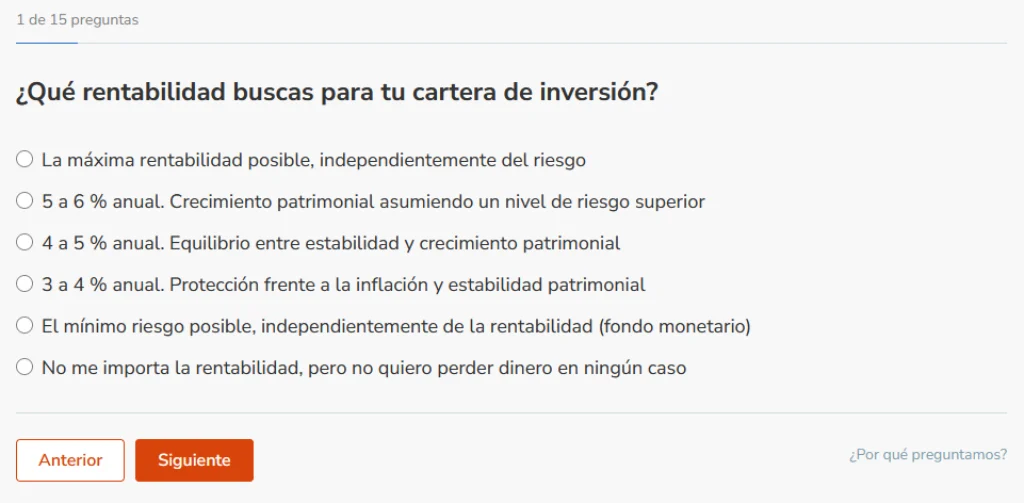
Risk profile assessment
It's also important to assess your risk tolerance. This is crucial, as it will determine how your portfolio is structured.
- Conservative Profile: Prefers low-risk investments (e.g., fixed income such as bonds).
- Moderate Profile: Accepts some volatility (e.g., a combination of 60% fixed income and 40% equities; we will discuss fixed income and equities later).
- Aggressive Profile: Seeks to maximize profits, accepting greater risks (e.g., equities in +60% of the portfolio).
Below you can see an example of the evaluation carried out by Indexa Capital:
Where to start investing
It is usual to use the services of a stockbroker to start investing, as they will act as an intermediary between you and the market.
Of course, you can also use your bank's services, but I don't recommend it because you won't find the same investment opportunities and the fees are usually much higher. A broker is always the best option; just make sure they are regulated, as this will guarantee that your money is in good hands.
Long-term investment: time and consistency
Anyone who's seen any of my YouTube videos knows I enjoy trading. What they might not know is that even though I dedicate a large part of my time to trading, I never neglect the long term (over 10 years). Investing with a time horizon of more than 5 years is always necessary.
My long-term investments range from betting on Chinese companies with Alibaba shares, to buying barrels of whiskey, or using a Robo Advisor (What is a Robo Advisor?).
With the Robo Advisor, what I do is contribute the same amount of money month after month; this is called DCA (Dollar Cost Average).
Dollar-cost averaging (DCA) is an investment strategy that involves buying an asset at regular intervals, regardless of its price. This technique is especially useful in volatile markets, such as the cryptocurrency market, where prices can fluctuate dramatically in short periods of time.
The main idea behind DCA is that by investing a fixed amount of money in an asset at regular intervals, the acquisition cost can be averaged out
You can do dollar-cost averaging (DCA) by buying stocks, ETFs, cryptocurrencies, or, as in my case, by using a robo-advisor. The best thing about DCA is that you can do it with a very small investment.
Get this through your head: it's not true that you need a lot of money to start investing. Especially not when you're young and have your whole life ahead of you.
Your greatest ally when investing is always time. I wish I had read an article like this when I was 20.
Of course, not all investment options are the same, or suitable for everyone. You should choose the one that best suits your personality and needs.
If you have a high risk aversion, you might prefer to avoid starting by investing in highly volatile assets, but this shouldn't prevent you from investing altogether, as there are many other options that might be right for you. The only thing you need to keep in mind when investing long-term is that diversification is key.
After this long introduction, I will share some fundamental considerations that you should evaluate when starting to invest.
5 steps to build your investment portfolio
Step 1: Define your life projects
Before thinking about investments, it's essential to have a clear understanding of your life goals. This includes defining what you want to achieve in the short, medium, and long term. Ask yourself:
- What do I need for emergencies?
- What do I want to achieve in the next 5-10 years?
- How do I plan my retirement?
Having clarity on these aspects will help you make more informed decisions about how and where to invest your money.
Step 2: Set deadlines for your projects
Once you have your projects clearly defined, assign deadlines to each one. This will allow you to choose the appropriate investment instruments. For example:
- Short term: Immediate needs, such as an emergency fund.
- Medium term: Projects such as your children's education or renovations.
- Long term: Savings for your retirement.
Step 3: Get to know the investment markets
It is essential to understand the different investment markets. The two main ones are:
- Fixed Income: Safer investments, such as bonds, where you lend your money in exchange for a fixed interest rate.
- Equities: In equities, the return on investment is neither guaranteednor known in advance. The classic example is stocks, where you buy a share of the company and participate in its profits. Other products I recommend for long-term equity investing are ETFs or mutual funds (the investment plans offered by XTB are a very good option to start with, as they are basically portfolios of ETFs).
When building a portfolio, you can play with the proportion of these two markets. If you're more conservative, your portfolio will have more bonds, while if you're more ambitious, you might want a larger proportion of stocks.
Don't think this is complicated to implement. Let's say you want to make regular contributions of $100 to an investment plan. You could have just two ETFs in it: one with technology stocks where 40% of your $100 would go, and another ETF with bonds where the remaining 60% would go (you have ETFs with debt securities from almost every country to choose from). You can even automate this with your broker. It's the same thing I do with the Robo Advisor from Indexa Capital.
Step 4: Play with the deadlines
In the fixed-income market, you can choose from different maturities. Depending on the country, you can opt for bonds with maturities ranging from 3 to 30 years. The choice of maturity will depend on your liquidity needs and the returns you expect to receive.
Step 5: Understand volatility
Volatility is a key concept in investing. Unlike risk, which refers to the possibility of losing money, volatility refers to fluctuations in the value of your investments. Diversifying your portfolio can help you manage this volatility .
Step 6: Diversification
Diversification is key to reducing risk. You can diversify through :
- Asset type: Fixed income and variable income.
- Currency: Euros, dollars and pesos if you are in Latin America.
This will allow you to have a more balanced portfolio, less susceptible to market fluctuations. Diversification is key. As I mentioned, I even invest in barrels of whiskey.
Step 7: Assign percentages to your investments
Once you have a clear understanding of your projects and timelines, it's time to decide how to allocate your capital. You can create a table to help you visualize how to distribute your money among different assets and markets.
Step 8: Review and adjust your portfolio
Finally, it's important to review and adjust your portfolio regularly. Market conditions change, and so do your needs. Stay informed and be prepared to make adjustments as necessary.
My name is Norberto. I've been investing and trading for over a decade. I'm also the author of the Topstep Experience trading course. If you want to learn how to invest and have any questions, feel free to contact me.
You might also be interested in