

If you've made it this far, you've probably seen a YouTube video, a thread on X, or heard a friend tell you that "you can make a lot of money trading." And yes, you can. But you can also lose it quickly. Sometimes in the same week.
Trading, simply put, is a financial activity where you buy and sell assets with the goal of making a profit in the short or medium term. We're not talking about buying something and forgetting about it for 10 years. We're talking about entering, managing, exiting. Repeating. With rules. With a cool head. Or with emotions, and that's where it gets complicated.
In this article, I'm going to explain what trading is, the most common types, how it differs from investing, what tools are used, and what you should consider before choosing a broker. No false promises. Just the facts.
What is trading?
Trading is the buying and selling of financial instruments to profit from price movements. In other words, you try to buy lower and sell higher. Or the opposite if you short sell, but let's not get too complicated just yet.
Which instruments? The most typical ones:
- Stocks (Apple, Tesla, banks, etc.)
- Currencies (Forex) (EUR/USD, GBP/JPY…)
- Cryptocurrencies (BTC, ETH…)
- Indices (S&P 500, NASDAQ, DAX…)
- Futures (widely used in professional trading)
- ETFs (more typical in investment, but they are also “traded”)
The basic idea is the same: the price moves, and you try to capture a part of that movement. Sometimes it lasts minutes, sometimes days, sometimes weeks.
And listen, this is important. Trading isn't just about entering and exiting positions. What separates a beginner from someone who survives (and then wins) is everything in between: risk management, position sizing, stop-loss orders, and emotional control.
Trading vs. investing (they are not the same, although they are often mixed)
This is very confusing.
Investing is usually:
- Long horizon (years)
- Fewer operations
- Objective: sustained growth, dividends, compound interest
- More focus on fundamentals, company, sector, economy
Trading usually involves:
- Short or medium horizon (minutes to months)
- Many more operations
- Objective: to capture price movements
- More focus on execution, timing, risk management, technical analysis (though not always)
A quick way to look at it: investors can afford to "wait." Traders almost never can. Because their plan already had an exit point, for better or for worse.
And yes, some people do both. They have an investment portfolio and also trade a small portion of it. But unintentionally mixing the two is a classic mistake: "this was a trade" and suddenly it becomes a "long-term investment" because it's losing money. A bad sign.
Most common types of trading
There are more styles, but these three are the ones you'll hear all the time.
1) Day trading
Day trading involves opening and closing trades within the same day. You don't leave positions open overnight.
What it involves:
- Keep an eye on the market (quite a bit)
- Make quick, but not impulsive decisions
- Accept that there will be no operations on some days
- Have a clear plan for arrivals and departures
Many choose it because it avoids nighttime risks (news, opening gaps). But it comes at the cost of being more "on top of things." If you have a job and a family, it's possible... but it's not always realistic to do it well.
2) Swing trading
Swing trading seeks larger movements and leaves trades open for several days, weeks, or even months.
Why is it so popular?
- It is more compatible with normal life, work, and studies
- It gives you more room to think and plan
- Less stressful than watching every one-minute candle
However, you do run the risk of unexpected news. That's why controlling position size and stop-loss orders becomes even more important here.
3) Scalping
Scalping is the fastest style. Very short trades seeking small profits repeated many times .
And here's the truth: it's one of the most difficult styles for a beginner, even though it may seem otherwise.
- He is very demanding regarding commissions, spreads, and execution
- A small mistake is very noticeable
- Psychological pressure increases
- Automation, robots, or highly mechanical systems are commonly used
Can it be done manually? Yes. Is it ideal for beginners? Usually not.
How a trader makes money (and how they lose it)
A trader wins when the market moves in their favor and they exit according to their plan. But the key point is this: the real difference isn't "being right a lot." It's losing little when you're wrong.
Most beginners do the opposite:
- Cut profits quickly "just in case it turns around"
- Let losses run "to see if it comes back"
And that, over time, will blow your bank account.
In trading there are three pillars that are repeated time and time again:
- Strategy (what conditions are you looking for to enter)
- Risk management (how much you risk per trade, stop loss, position size)
- Psychology (discipline, patience, emotional control)
If one fails, the rest collapses. It's that simple.
Tools and platforms for trading
Popular trading platforms
MetaTrader 5
To start trading, you need a good trading platform. Some of the best-known ones are:
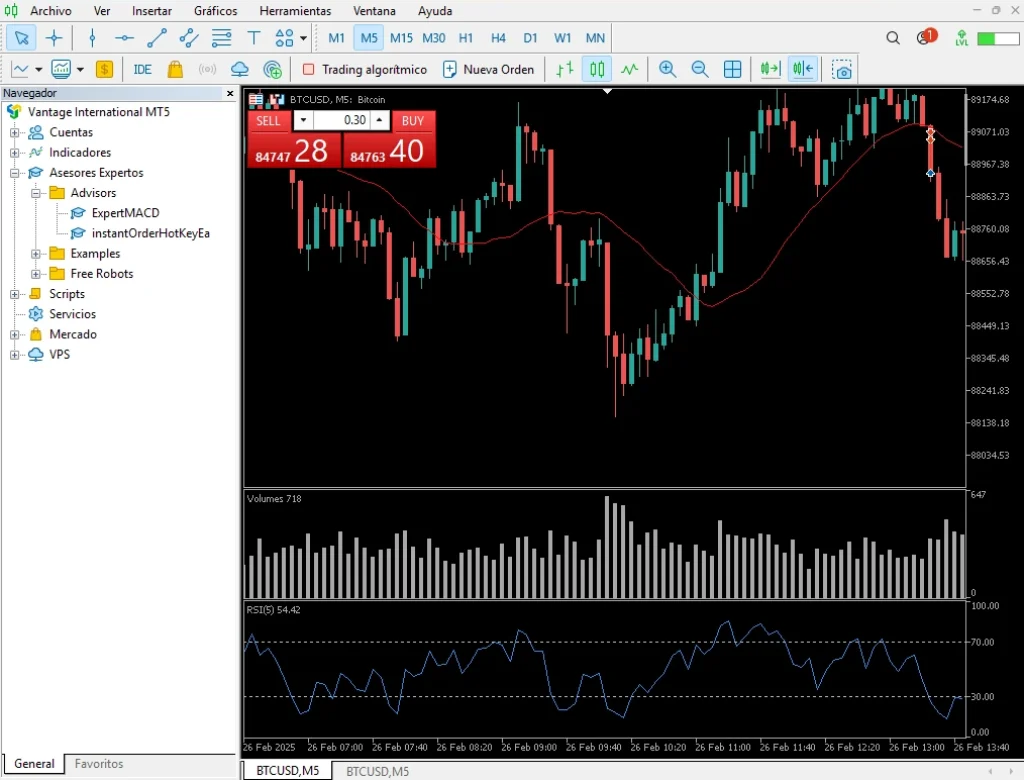
- MetaTrader 4 and 5: These are the most popular trading platforms. MetaTrader was created for Forex trading, but it's now also used for other instruments (stocks, indices, etc.). It's free and very comprehensive. I usually use it when trading with Vantage.
- TradingView: Ideal for both beginners and experts. It's one of my technical analysis and the one I usually use for the analyses I upload to the Topstep Experience YouTube channel.
- xStation by XTB : The broker XTB offers one of the most versatile and user-friendly trading platforms
- cTrader: Initially designed for institutional trading, it is now popular among all traders due to its ease of use and multiple applications.
- NinjaTrader: Focused more on execution than analysis, it's ideal for trading futures. It's a paid service, but it has a demo account with limited features.
- eToro: This well-known stockbroker brings us the simplest platform on the market.
Technical analysis tools
Some essential tools are:
- Candlestick charts: They help visualize price movements and identify patterns.
- Technical indicators: Such as the RSI, MACD and moving averages, provide signals about possible market movements (many traders use them).
- Analysis software: Programs like MetaTrader and TradingView allow you to perform detailed analysis and customize charts.
Fundamental analysis tools
Fundamental analysis focuses on evaluating the intrinsic value of an asset. The most useful tools include:
- Economic calendars: They keep us up to date on important events that can affect the markets, such as interest rate announcements and employment reports.
- Financial reports: Reviewing companies' financial statements helps to understand their economic health.
- Market news: Staying informed about the latest news and trends is crucial to anticipating market movements.
Discover the ideal broker, course, or funding account for you with the help of AI.
- 📊 Tailored recommendations, based on your profile
- 🧠 Learn about investing and trading for free
- 🔍 Ideal for beginners and growing traders
Do you need a broker to trade and don't know where to start?
Get your questions answered by talking to an expert; they will guide you step by step through the account opening process.

Vantage Support in Spanish:
- 🌐 Online help
📧 support@vantagemarkets.com
🔒 Your money is protected by the strictest regulations in Australia and the UK (ASIC, FCA, etc).
Vantage Support in Spanish:
- 🌐 Online help
📧 support@vantagemarkets.com

Vantage: The best broker for your trading
- ✔️ Offers MetaTrader 4, MetaTrader 5 and other advanced platforms.
- ✔️ Outstanding customer service and fast order execution.
- ✔️ Requires a high minimum capital to access premium tools.
- ✔️ It is regulated by the FCA (UK) and ASIC (Australia).
- ✔️ Provides analysis and education to improve trader performance.

How to choose a broker
When starting out in trading, it's essential to select a reliable broker that offers an trading platform . Here are some points to consider when choosing a broker:
- Regulation and safety
- Commissions and fees
- Educational tools and resources
- Customer service
- Trading platform
Some of the most recommended and used brokers by traders are:
- Vantage: An Australian broker with excellent regulation that uses MetaTrader.
- XTB: Ideal for investing in ETFs and investment plans. Very user-friendly platform.
- Interactive Brokers: Wide range of services and very good reputation, although with a rather complex platform for beginners.
- eToro: Simple and easy to use. Ideal for getting started in stock trading.
Trading with Vantage and MetaTrader
How much can you earn with trading?
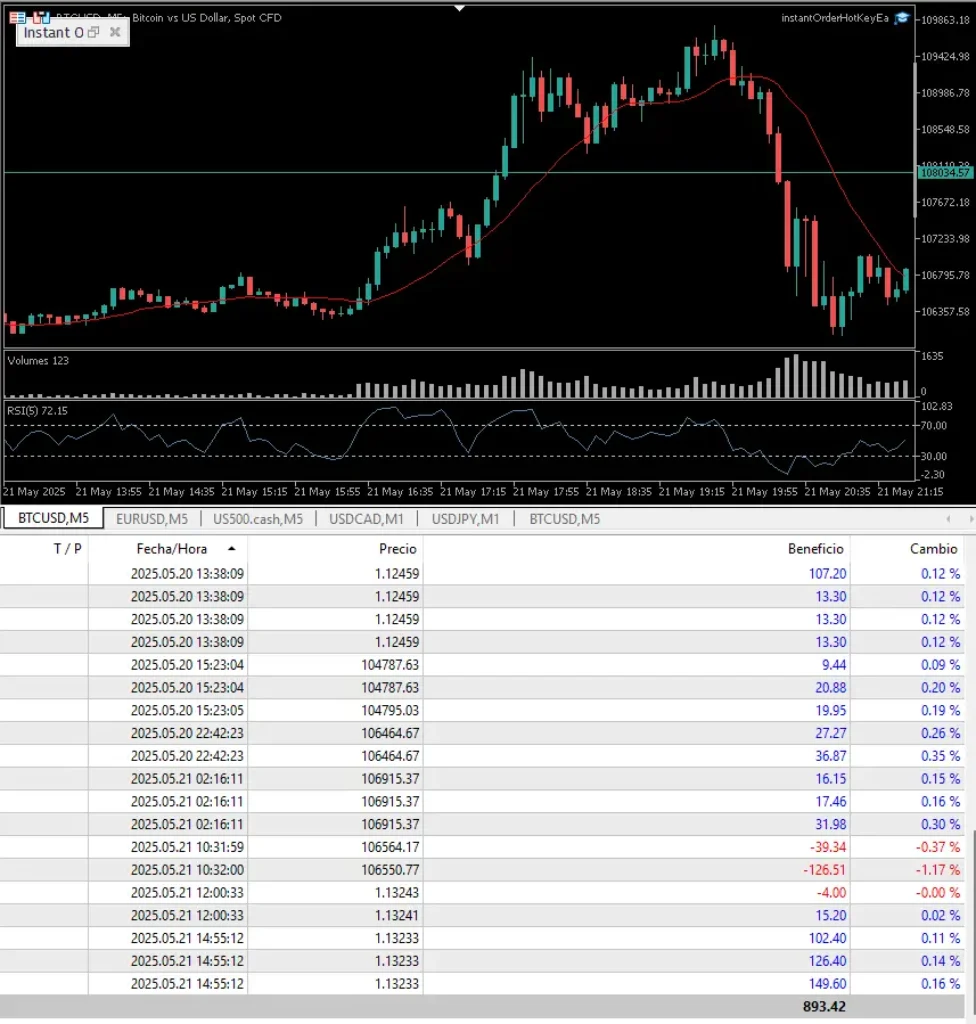
This question is very difficult to answer, as it depends on so many variables. I know traders who earn several thousand euros or dollars per day, but these are traders with a lot of experience and manage fairly large accounts.
The truth is that when you start out you should focus more on not losing money than on making it, and only when you have found a trading system that suits your personality and lifestyle can you think about making trading a source of income.
In short, with experience you can earn a lot of money. But that only comes with practice and after studying extensively.
Basic trading strategies
Technical analysis vs. fundamental analysis
In the world of trading, there are two main approaches to analyzing the market: technical analysis and fundamental analysis.
Technical analysis is based on studying charts and price patterns to predict future movements. On the other hand, fundamental analysis focuses on evaluating the intrinsic value of an asset, considering economic and financial factors.
In the following video, I'll show you in just a few minutes how I trade using technical analysis:
Risk management
Risk management is crucial for any trader. Here are some basic tips:
- Diversification: Don't put all your eggs in one basket. Invest in different assets to minimize risk.
- Stop-loss : Use stop-loss orders to limit your losses if the market does not behave as you expected.
- Position size: Do not risk more than 1-2% of your capital on a single trade.
Trading Psychology
This is where it all becomes real.
Trading confronts you with:
- fear of losing
- FOMO (fear of missing out)
- revenge (I want it back now)
- euphoria (I feel invincible)
- paralysis (I don't execute my plan)
The solution isn't to be "cold" like a robot. The solution is to have simple, repeatable rules and follow them even when you don't feel like it.
Discipline, patience, emotional control. It sounds like a slogan, but it's literal.
Risk management
If I had to leave you with just one idea: in trading, your number one job is not to go bankrupt.
Basic things that are usually used:
- Stop loss: a point where you accept the loss and exit.
- Position size: it's not the same to enter with 10 euros as with 1,000.
- Risk per trade: many serious people risk 0.5% to 2% of their account per trade (depending on the system)
- Diversification: Don't put everything into the same type of operation or asset.
- Avoid overtrading: trading out of boredom is extremely expensive
And one more personal thing: if you're ever feeling out of sorts, tired, angry, or stressed, don't trade. The market will still be there tomorrow.
How to get started in trading
This would be a fairly sensible route, without any romanticizing.
1) Learn the basics for real
Minimum concepts:
- What is a market order vs a limit order?
- What is leverage (and why is it a weapon)
- What are spread, commission, and slippage?
- What are stop loss and take profit?
Courses, books, channels. For example, many people learn by watching real trading content on YouTube, such as Topstep Experience (focused on more professional mindsets and environments, especially if you're interested in the world of Futures).
There are also more specialized training programs, such as Order Book Trading, if you're interested in the order flow approach. It's not mandatory to start with, but that option exists.
2) Practice in demo (yes, demo)
A demo doesn't teach you the thrill of real money, but it does teach you:
- to use the platform without errors
- to run your system
- to measure results with data
The demo is like a driving simulator. It's not highway driving, but it's better than crashing on the first day.
3) Convert to real with little money
When you move to real football, the priority isn't winning a lot. It's not losing while training with real emotions.
If you go in expecting to "live off trading in 3 months," you're going to force yourself to trade poorly. And the market punishes that.
4) Consider funded accounts
Many people train with the idea of accessing funding accounts . It's not easy, nor is it a shortcut, but it's a real option: you demonstrate consistency with the rules and they allocate capital to you under certain conditions.
Conclusion
In short, trading is a potentially very lucrative activity, but it is not without risks. And although it may seem similar to investing, trading requires a more active approach and a deep understanding of the market.
If you decide to enter this world, it is crucial that you educate yourself well and practice before making your first stock market transaction.

My name is Norberto. I've been investing and trading for over a decade. I'm also the author of the Topstep Experience trading course. If you want to learn how to invest and have any questions, feel free to contact me.
You might also be interested in
HOW TO START INVESTING IN THE STOCK MARKET?

DAY TRADING: A COMPLETE GUIDE TO INTRADAY TRADING
A complete guide to day trading: strategies, tools, risk management…

BEST TRADING COURSES: ANALYSIS, COMPARISON AND REAL REVIEWS
Guide to choosing the right investment and trading course…









I want to educate myself to do trading. I'm new, I don't know anything, but I have that desire to learn and do this business
Excellent article. I, for example, enter pullbacks with limit orders. As you rightly point out, there's a risk in not knowing if the order will be filled and if it will go directly against you, but on the plus side, I can set a fairly small stop loss. In this sense, I feel more emotionally calm when trading, and I've ultimately decided that all my entries are with limit orders and on pullbacks using a 1-minute timeframe. On the other hand, I'm one of those who lets the price run and doesn't commit early. The problem with this? This month I was doing a funding test, and although I finished the month in the black, I failed because I had a five-day losing streak and exceeded the dynamic drawdown threshold. It's a shame, but it's made me change my approach and opt to take profits sooner, as you also mention in the article. I think that's the best way to pass these tests. Thanks for your input, and best regards!
Hi Luis,
It's a shame you failed. But there's always another chance. As they say, 'you only need to get rich once in the stock market' 🙂 – Regarding what you mentioned, one option I'm considering, but haven't tested yet on the funding accounts, is to trade within a range using Volume Profile. This way, the trade size will be significantly smaller, but you'll have a better chance of passing the test and your risk will be minimal. I'll share my experiences here.
Greetings