
Valorar una empresa no es lo mismo que hacer trading
La valoración de empresas es un arte que requiere práctica y comprensión de los distintos métodos disponibles. Recuerda que cuando aquí hablamos de valorar una empresa estamos hablando de una estrategia para invertir a largo plazo comprando acciones (esto no es hacer trading).
Lo cierto es que la valoración de empresas es parte de lo que llamamos análisis fundamental, y este no tiene secretos. Solo debes saber cómo hacerlo. Aquí te mostraré algunos métodos para que puedas empezar.
Resumen del artículo
- La valoración de empresas es esencial para determinar el precio justo de las acciones.
- Existen varios métodos de valoración, siendo el EBITDA, EBIT y el Free Cash Flow los más destacados.
- Los múltiplos de valoración nos ayudan a entender cuánto tiempo tomará recuperar nuestra inversión.
- Herramientas Gratuitas: Koyfin y los informes anuales de las empresas son esenciales para el análisis.
- Comparación Histórica: Es importante conocer la media histórica de la compañía y su sector para realizar una valoración precisa.
¿Qué es la valoración de empresas?
La valoración de empresas es el proceso de determinar el valor intrínseco de una compañía. Es una herramienta financiera clave que nos ayuda a entender el valor real de una compañía, ya sea para venderla, fusionarla o simplemente para tomar decisiones estratégicas (compra de acciones). Esto nos permite saber si el precio de las acciones es justo, caro o barato.
Objetivos de la valoración
Los objetivos de la valoración de empresas son variados. Algunos de los más comunes incluyen:
- Venta de la empresa: Saber cuánto vale tu empresa es crucial si estás pensando en venderla.
- Fusiones y adquisiciones: En estos casos, es importante conocer el valor para negociar mejor.
- Atracción de inversores: Una buena valoración puede atraer a posibles inversores.
- Compra de acciones: Valorar correctamente una empresa puede presentar oportunidades interesantes de compra de acciones.
Métodos de valoración
Existen varios métodos de valoración, pero nos enfocaremos en los más utilizados:
- EV/EBITDA: Este método relaciona el valor de la empresa con su EBITDA. Para calcularlo, dividimos el Enterprise Value (EV) entre el EBITDA anual. Un múltiplo bajo indica una buena oportunidad de inversión.
- EV/EBIT: Similar al anterior, pero utiliza el EBIT. Este método también es popular entre los analistas y puede ofrecer buenos resultados si se aplica correctamente.
- PER (Price Earnings Ratio): Este es uno de los métodos más conocidos. Relaciona el precio de la acción con el beneficio neto de la empresa. Aunque es ampliamente utilizado, no siempre es el mejor, ya que no considera la deuda ni la caja de la empresa.
- EV/FCF (Free Cash Flow): Este método es considerado uno de los más conservadores, ya que relaciona el valor de la empresa con su flujo de caja libre. Es una forma más pura de valorar una empresa, ya que incluye su posición financiera.
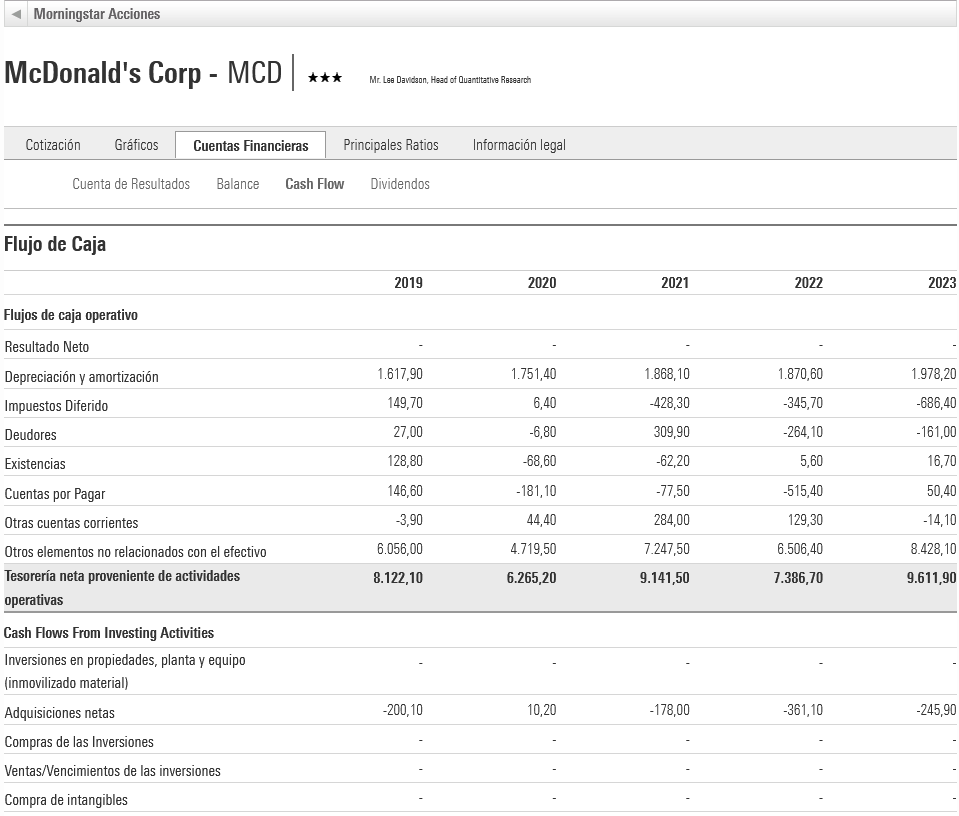
Los números de McDonald’s
Dejabo puedes ver un pantallazo con los datos de flujo de caja de McDonald’s (por cierto, te recomiendo la película The Founder sobre la historia de McDonald’s, no habla de finanzas pero si te gustan las empresas y tienes espíritu emprendedor seguro te gusta).
Ejemplo práctico
Imaginemos que estamos interesados en comprar un McDonald’s que tiene un precio de venta de 10 millones de euros (los números no están actualizados, solo sirven para el ejemplo). Para determinar si este precio es justo, necesitamos calcular los múltiplos de valoración:
- Ventas: 5 millones de euros
- EBITDA: 15 millones de euros
- EBIT: 13 millones de euros
- Beneficio Neto: 900 mil euros
- Free Cash Flow: 1 millón de euros
Si el Enterprise Value es de 9 millones de euros (10 millones de euros menos 1 millón en caja), podemos calcular los múltiplos:
- EV/EBITDA: 9 / 15 = 0.6
- EV/EBIT: 9 / 13 = 0.69
- PER: 10 / 0.9 = 11.11
- EV/FCF: 9 / 1 = 9
Estos múltiplos nos indican cuántos años tomará recuperar nuestra inversión. Por ejemplo, si compramos el McDonald’s usando el múltiplo de EBITDA, tardaríamos 6 años en recuperar nuestra inversión, mientras que con el múltiplo de Free Cash Flow, tardaríamos 9 años.
Múltiplos de valoración: ¿Qué son?
Los múltiplos de valoración son herramientas que nos permiten comparar el valor de una empresa con su rendimiento financiero.
Estos múltiplos, como el EBITDA o el PER, son fundamentales para determinar si una acción está cara o barata. Sin embargo, es crucial tener un punto de referencia para hacer esta evaluación. Usualmente estos múltiplos se comparan con los de empresas similares para determinar el valor de tu empresa.
La importancia de la comparación
Para saber si un múltiplo es caro o barato, debemos compararlo con la media del mercado o con competidores en el mismo sector. Por ejemplo, si un negocio tiene un múltiplo de 6 veces EBITDA, necesitamos saber si eso es razonable en comparación con el promedio del mercado, que suele estar alrededor de 10 veces.
Datos clave del mercado
Algunos datos de referencia que debes considerar son:
- Crecimiento promedio de ventas: 8%.
- ROI promedio: 13%.
- Ciclicidad: Moderada.
- Deuda neta promedio: 2 veces.
Volviendo al ejemplo de McDonald’s, supongamos que tiene un crecimiento de ventas del 20% y un ROI del 25%. Si comparamos estos datos con la media del mercado, podemos concluir que McDonald’s es un negocio de mayor calidad y crecimiento. Esto sugiere que los múltiplos que el mercado debería estar dispuesto a pagar son más altos que el promedio.
Oportunidades de inversión
Si encontramos una empresa que cumple con los criterios de crecimiento y calidad, y que cotiza a múltiplos inferiores a la media, podríamos estar ante una excelente oportunidad de inversión. Por ejemplo, si McDonald’s cotiza a 6 veces EBITDA en lugar de 10, esto representa un 40% de descuento respecto al múltiplo promedio del mercado.
Riesgos a considerar
Es importante tener en cuenta que, aunque una acción parezca una buena oportunidad, siempre existe el riesgo de que el múltiplo se comprima. Esto puede suceder si hay problemas en la empresa que no se han revelado. Por ejemplo, si compramos McDonald’s a 10 veces EBITDA pero luego descubrimos que los beneficios caerán un 40%, el múltiplo podría ajustarse a 6 veces, resultando en una pérdida significativa.
Herramientas para el análisis
Para realizar un análisis efectivo, puedes usar dos herramientas clave:
- Koyfin: Una plataforma gratuita que ofrece un resumen de métricas financieras y permite acceder a los estados contables de las empresas (Morningstar y TIKR son dos alternativas interesantes pero gran parte de las herramientas que ofrecen son de pago).
- Informes anuales: Acceder a los informes anuales de la empresa es crucial para obtener información detallada.
Cursos de bolsa para invertir a largo plazo recomendados:
- PV ESCUELA de FINANZAS por Enrique Valdecantos: Este es mi curso de valoración de empresas favorito, como ya he dicho, en la valoración de empresas no hay secretos pero si quieres acelerar tu aprendizaje este curso es ideal.
- ARTE de INVERTIR de Alejandro Estebaranz: es un curso de inversión online diseñado para enseñar a personas con poco o ningún conocimiento previo sobre inversiones a construir una cartera sólida a largo plazo. Se enfoca en una metodología de inversión de valor, similar a la utilizada por grandes inversores como Warren Buffett y Peter Lynch.
- INVERTIR DESDE CERO: Este curso es muy similar al de Alejandro Estebaranz, la diferencia la hace el instructor. Ambas opciones son totalmente recomendables.
Ejemplo de análisis fundamental
Conclusión
Valorar acciones es un arte que requiere práctica y conocimiento. Utilizando herramientas adecuadas y comprendiendo los estados contables de las compañias, cualquier inversor puede aprender a valorar empresas de manera efectiva.
No obstante, debes saber que no es tan fácil encontrar gemas ocultas en el mercado, y mucho menos poder saber lo que sucederá en el largo plazo. Tu análisis puede ser muy bueno, pero al invertir a largo plazo te expones a un tipo de incertidumbre que va mucho más allá de los números de las empresas. Un juicio, un nuevo competidor que surge, un producto que el mercado no ve con buenos ojos, etc. Todo eso puede pasar, pero tu análisis no lo contemplaba.
Con esto no quiero decir que la valoración de empresas a través de sus múltiplos no sirva, sino que tengas claro que no es la respuesta a todo.

Soy Norberto. Llevo más de una década invirtiendo y haciendo trading. También soy el autor del curso de trading Experiencia Topstep. Si quieres aprender a invertir y tienes dudas, escríbeme.
También te puede interesar
¿CÓMO EMPEZAR A INVERTIR EN BOLSA?

COMO GANAR DINERO DESDE CASA
Opciones y consejos prácticos para ganar dinero extra.

ANÁLISIS FUNDAMENTAL VS. ANÁLISIS TÉCNICO: ¿CUÁL ES MEJOR?
Descubre las diferencias entre el análisis fundamental y técnico